[ Japanese ]
ESG Governance
Basic Approach
The purpose and direction of ESG management
Rather than treating Environment (E), Social (S), and Governance (G) as separate areas of focus, the Sekisui House Group integrates them into its business itself, aiming to create ESG value. That’s why we see ESG not just as a management foundation, but as a source of value—and we promote ESG management that creates a positive impact through our business activities.
In an era in which addressing climate change and social issues is directly linked to maintaining corporate competitiveness, we believe promoting ESG management that drives value creation is central to achieving business growth. Through ESG management, we aim to realize the happiness of our customers, society, and employees, while enhancing corporate value and contributing to a sustainable society.
Structure for Promoting ESG Management
To promote ESG management across the entire organization, we have established three subcommittees: the Environmental Subcommittee, the Social Improvement Subcommittee, and the Governance Subcommittee. These subcommittees play a central role in advancing ESG initiatives by working closely with relevant departments and Group companies, both domestically and internationally. They are responsible for planning and implementing initiatives aligned with our material issues, as well as setting and monitoring relevant KPIs on an ongoing basis.
Each subcommittee is led by assigned senior leaders and regularly monitors progress on important issues to continuously improve initiatives. Progress on initiatives and identified issues are reported to the ESG Promotion Committee, which provides internal feedback and considers further improvement measures. Furthermore, to ensure that all employees understand and put ESG management into practice, the Company has established internal training programs and systems for sharing information.
ESG Management Promotion Structure (As of February 1, 2026)
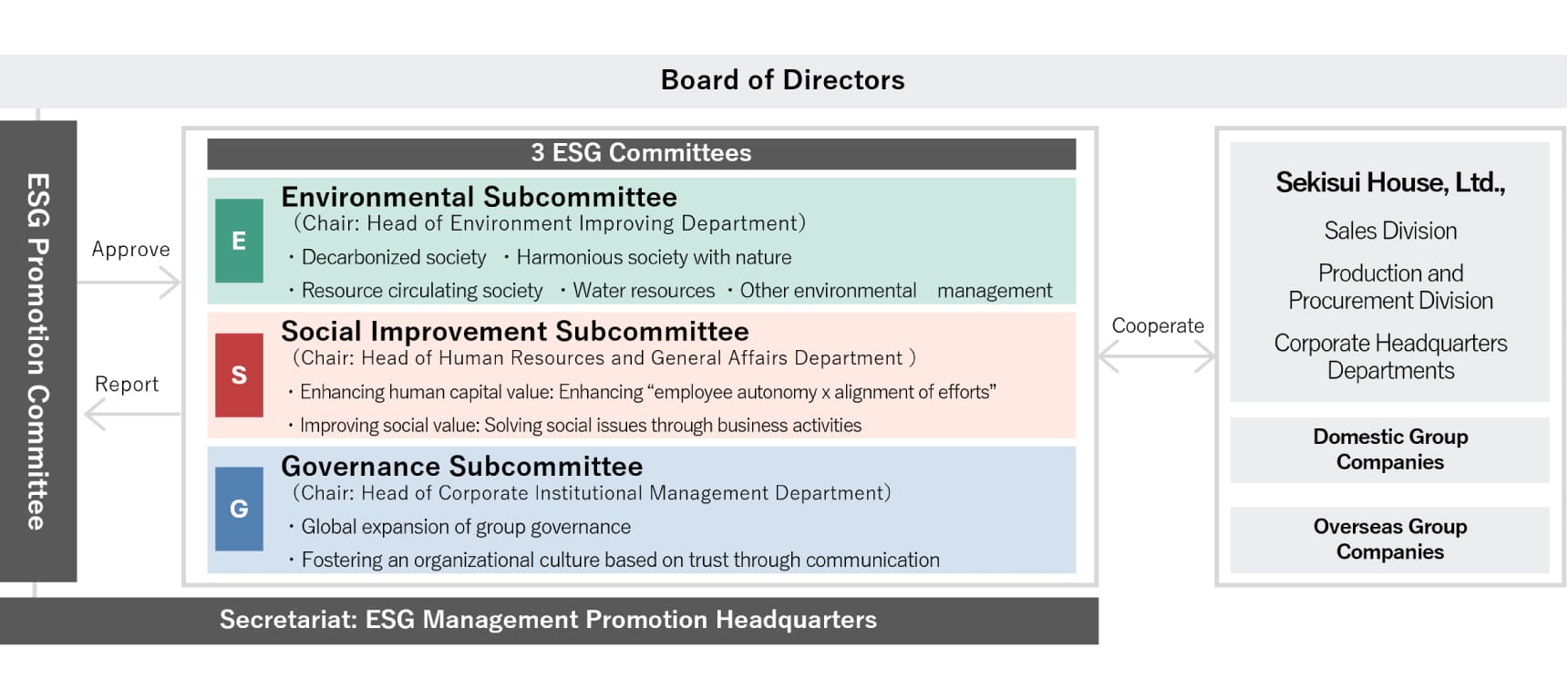
ESG management execution structure
To ensure the steady progress of ESG management, the Senior Managing Executive Officer, who is in charge of the ESG departments, assumes overall responsibility for ESG activities across the entire Sekisui House Group and oversees their promotion.
Moreover, the ESG Management Promotion Headquarters, established in June 2020, plans, develops, and manages the implementation of Company-wide initiatives related to our core ESG management policies. They oversee these Company-wide ESG management initiatives, gather and analyze information, and communicate insights both internally and externally, taking the lead in advancing our sophisticated ESG management.
Governance
To enhance the effectiveness of ESG management, Group has established the ESG Promotion Committee, an advisory body to the Board of Directors. Chaired by the Representative Director, Vice Chairman and Executive Officer¹ and consisting of both internal and outside members with specialized knowledge, this committee promotes ESG from an objective and multifaceted perspective.
The ESG Promotion Committee reviews reports on environmental, social, and governance-related activities and evaluates progress on important issues, revising relevant policies as necessary through active discussion.
The content of the ESG Promotion Committee’s quarterly meetings is reported to the Board of Directors and shared with all employees via the Company intranet, contributing to greater awareness and understanding of ESG throughout the Company.
ESG Management Promotion Structure (As of February 1, 2026)
| Chairperson | Haruhiko Toyoda(Senior Managing Officer ,In Charge of ESG Management Promotion Division, Head of External Affairs Department) |
|---|---|
| Outside members |
Katsuhiko Kokubu (Professor, Graduate School of Business Administration, Kobe University) Hidemi Tomita (Institute for Sustainability Management CEO) |
| Internal members | Head of the ESG Management Promotion Headquarters, the respective chairpersons and vice chairpersons of the three ESG subcommittees, etc. |
Note: Directors of the Board, Audit and Supervisory Board members and Executive Officers of the rank Managing Officer and above may attend as observers.
Main Agenda of the ESG Promotion Committee for FY2025
| 21st meeting, held in March 2025 |
|
|---|---|
| 22nd meeting, held in May 2025 |
|
| 23rd meeting, held in July 2025 |
|
| 24th meeting, held in October 2025 |
|
| 25th meeting, held in January |
|
Strategy
Guided by our Global Vision, “Make Home the Happiest Place in the World,” we have positioned ESG management as the core of our business strategies, aiming to contribute to a sustainable society as well as the Company’s sustainable growth. The fundamental strategy of ESG management lies in integrating the three aspects of “Environment,” “Social” and “Governance” to generate a positive impact through the Company’s business activities. To that end, we have aligned our long-term vision with the Mid-Term Management Plan, driving our initiatives forward.
Material issues
In 2022, to clarify the mission we should fulfill, the Group reviewed its material issues. In doing so, we identified and assessed issues that are both important to stakeholders and represent significant economic, environmental, and social impacts; deliberated on the long-term challenges and social missions that the Sekisui House Group ought to undertake; and reflected on our historical initiatives to date. We deepened our understanding through discussions at Management Meetings and through the exchange of opinions with various stakeholders, including external experts.
In the 1960s, the Group contributed to securing housing during the period of rapid economic growth and elevating the basic performance of housing. Since then, we have been consistently pursuing “safety and peace of mind” and “comfort and environmental consideration” in housing, while working to advance technologies. Recognizing that our efforts themselves are material issues, we have identified three material issues: “Creation of High-Quality Housing Stock,” “Contributing to a Sustainable Society,” and “Diversity and Inclusion” in achieving happiness through housing in the era of the 100-year lifespan.
Process of Identifying Material Issues
-
Identifying and organizing key themes
Reflecting on our history since our founding, we identified eight paramount and enduring themes.*1 We identified their interplay with our business activities and reasserted that our historical initiatives to date align with “Love of Humanity,” the fundamental philosophy underpinning our Corporate Philosophy. -
Writing our corporate story
Based on eight themes, we categorized the innovations we have developed and the employees that have supported them, constructing a corporate story that covers each 30-year stretch as a single phase. We identified social issues related to our business activities, determining the elements vital to our business activities and the creation of value. -
Identifying material issues
We identified three priority areas that need to be addressed based on our corporate story. Subsequently, with approval from the Board of Directors and through discussions among top management as well as deliberations by the ESG Promotion Committee, which includes external experts, these three areas have been designated as our core material issues of the Sekisui House Group.
*1These eight key themes are: seismic resistance performance; landscape and aesthetics; ecosystem preservation and biodiversity; insulation performance and CO2 reduction; resource recycling; coexistence with local communities; health, connectedness and learning; and employment retention and human resource development.
Background for determining material issues and our mission
|
Background: In Japan, a country prone to earthquakes and other natural disasters, many homes fail to meet seismic and thermal insulation standards, and the aging of existing housing stock is prevalent. Moreover, the housing shortage problem is worsening globally, and supplying housing that maintains long-term value while providing safety, security and comfort, has become a critical concern. Through the creation of high-quality housing stock, we aim to contribute to the sustainable development of regional communities and the global environment, while improving people’s lives and asset value. Our mission: Offer valuable homes designed to endure for generations by committing to delivering residences that blend functionality and beauty. |

|
Background: Global environmental issues such as climate change, loss of biodiversity and resource depletion are intensifying, placing an immediate priority on transitioning to a decarbonized society. Energy conservation, CO2 reduction and the shift towards a circular economy have also become key issues in the Japanese housing industry. The Sekisui House Group is dedicated to achieving a sustainable society in partnership with diverse stakeholders by providing environmentally friendly houses and buildings, advancing technological developments, offering high-quality services, and striving to coexist with local communities. Our mission: Pioneer a future where people can continue to live with greater happiness by actively advancing environmental impact reduction and renewable energy utilization, and fostering cooperation with local communities. |

|
Background: Amid labor shortages caused by a declining population, workstyles and lifestyles not bound by specific values or conventional norms are becoming more widespread. To create new value, it is important to build an organization with diverse talents and foster an inclusive corporate culture where each other’s differences are respected. Guided by our vision, we strive to build workplaces focused on employee health and happiness, where all employees, who serve as source of innovation, can seize equal opportunities to thrive. Our mission: We are committed to creating work environments that honor diverse perspectives and values, where each individual can confidently harness their traits and skills to excel in their roles. |
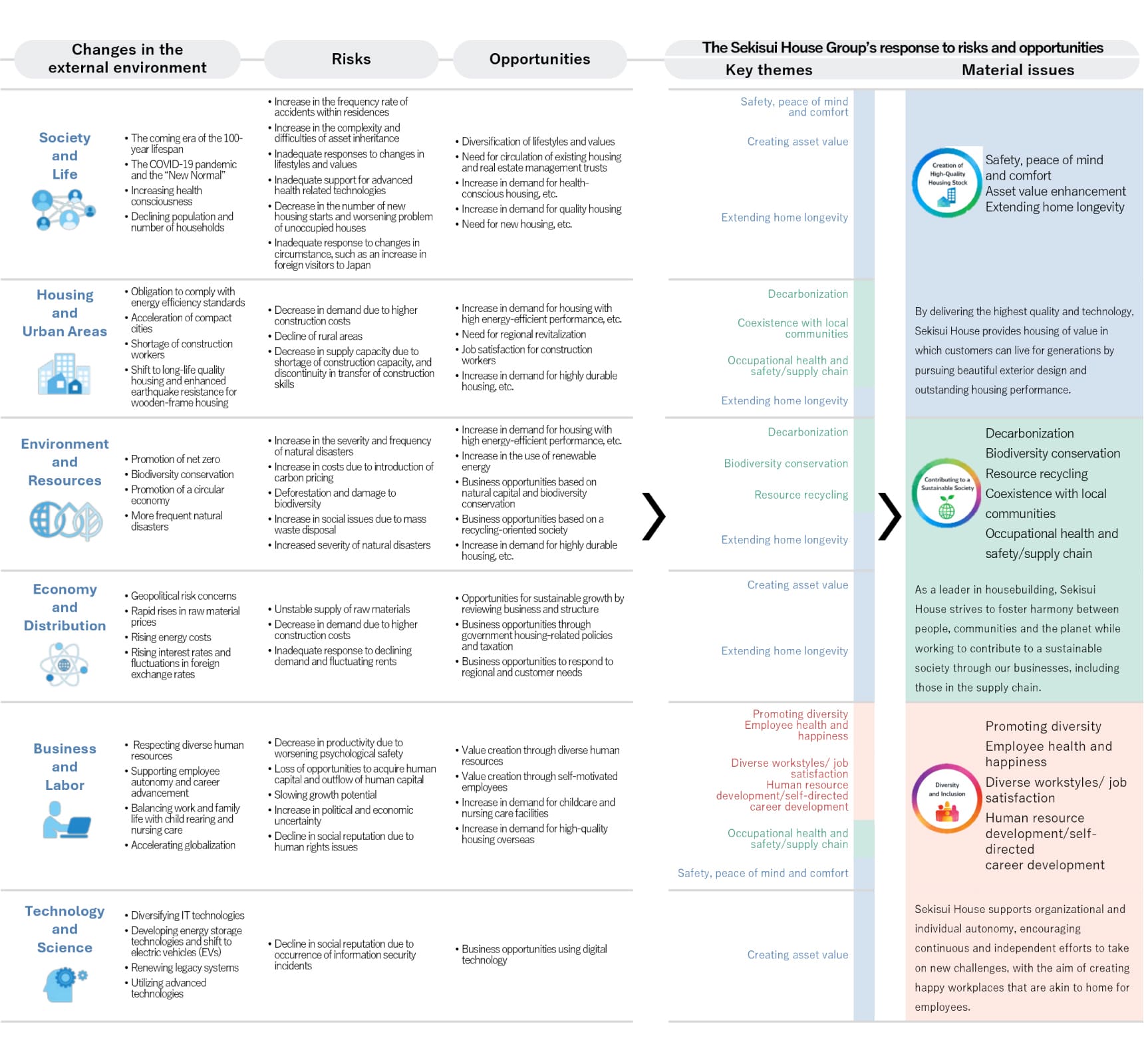
The Sekisui House Group analyzes the risks and opportunities associated with changes in the external environment. We consider what value we can provide to realize the happiness of our stakeholders, including customers, society, and employees. Based on our three material issues, we establish key themes.
In the Sixth Mid-Term Management Plan (FY2023–FY2025), we have set specific initiatives and progress indicators for each key theme, and we continued to promote and manage progress under the ESG management promotion structure.
In addition, the Group has been reviewing and refining its material issues through ongoing dialogue with internal and external stakeholders in light of changes in the social environment and the diversification of values. As a result, with respect to the material issues to be applied from FY2026, we will continue to position “Creation of High-Quality Housing Stock” and “Contributing to a Sustainable Society” as priority issues. At the same time, the previously identified material issue of “Diversity and Inclusion” has been reviewed and further developed, and “Fostering a Refined Sense of Beauty and Happiness” has been newly identified as a material issue. This review aims to further clarify the value that the Group should create over the medium to long term through its business activities, based on the Group’s progress in creating social value through homebuilding since its founding. Under the Seventh Mid-Term Management Plan (FY2026–FY2028), we will place these material issues at the core of our initiatives and, under the newly established basic policy for ESG management, “Become a leading company in ESG management creating new value,” further advance ESG management and pursue the sustainable enhancement of corporate values.
Risk Management
With sustainability at the core, the Group analyzes medium- to long-term challenges that could affect value creation, identifies risk factors, and positions risk as an opportunity for future business creation, leading to the formulation of medium- to long-term business strategies. The progress and challenges of ESG management initiatives are examined by the ESG Promotion Committee, an advisory body to the Board of Directors, and then reported to the Board of Directors. The Board of Directors receives reports from the ESG Promotion Committee and deliberates and supervises the Group’s sustainability-related initiatives.
Furthermore, matters related to operational risks and hazard risks are appropriately shared with the Risk Management Committee, which is also an advisory body to the Board of Directors, and are examined and managed within the Group’s overall risk management structure.
For details on risk management related to sustainability agendas—such as initiatives related to climate change, natural capital and biodiversity, human capital and respect for human rights—as well as business risks, please refer to the Annual Securities Report (The 75th Fiscal Year).
Metrics and Targets
The Sekisui House Group has established quantitative non-financial indicators (KPIs) based on its material issues to achieve both social sustainability and continuous corporate growth. Progress is managed and evaluated under the ESG management promotion structure, with revisions made as necessary. In the Sixth Mid-Term Management Plan (FY2023–FY2025), 54 KPIs have been established in connection with our three material issues. These KPIs are positioned not only as tools for performance tracking but also as key indicators that guide the direction of value creation through ESG management. Accordingly, when establishing these KPIs, we utilize the following fundamental policy.
1. Incorporating a double materiality perspective
The Sekisui House Group places importance not only on its financial impact, but also on its impact on society and the environment, setting KPIs aimed at creating both economic and social value.
2. Balancing social impact and corporate growth
With a focus on value creation through ESG initiatives, we emphasize indicators designed to maximize positive impact.
3. Setting KPIs with a focus on stakeholder dialogue
We establish indicators that reflect the expectations of diverse stakeholders—such as customers, partner companies, local communities, employees, and investors—and promote highly transparent information disclosure.
4. Conducting ongoing reviews and updates
KPIs are periodically reviewed and refined in line with societal and environmental changes and developments in the business landscape, promoting the evolution of ESG management.
Materiality management
The Sekisui House Group’s materiality management aims to accurately recognize changes in society and developments in the business landscape, with the goal of maximizing value creation through ESG management. Therefore, the initiatives we promote go beyond risk management. They also focus on enhancing both corporate and social value by closely linking material issues to our growth strategy.
Integrating ESG management into our business strategy
The Sekisui House Group aims to achieve sustainable growth by integrating ESG perspectives into its business strategy. To this end, we have incorporated ESG management initiatives into KPIs and introduced a system to quantitatively assess the results of ESG-related business activities. In addition, the progress and outcomes of the ESG strategy are regularly reported to the ESG Promotion Committee and the Board of Directors, and strategies are reviewed as needed.
Key steps in materiality management
1. Identifying key themes
By engaging in dialogue with stakeholders and analyzing risks and opportunities, the Sekisui House Group is exploring areas where it can continuously provide value. Furthermore, in line with the direction of ESG management, we have identified the following 11 key themes.
- Creating High-Quality Housing Stock: Safety, peace of mind and comfort; Creating asset value; extending home longevity
- Contributing to a Sustainable Society:Decarbonization; Biodiversity conservation; Resource recycling; Coexisting with local communities; Occupational health and safety/Supply chain management
- Diversity and Inclusion: Promoting diversity; Employee health and happiness; Diverse workstyles/Job satisfaction/Human resource development/Self-directedcareer development
2. Setting KPIs linked to material issues
To enhance the effectiveness of ESG management, KPIs are established for each material issue. In addition, the relationship between social impact and business growth is clarified to promote Company-wide understanding. The impact of business activities on stakeholders and the Sekisui House Group is also visualized, thereby continuously driving improvements toward sustainable growth. In the Sixth Mid-Term Management Plan, 54 KPIs*2 were established.
*2 We conduct regular reviews, and in fiscal year 2025, there were 52 indicators.
3. Regular monitoring and evaluating
Progress of KPIs during the three-year period of the Sixth Mid-Term Management Plan (FY2023–2025) is reported periodically to the ESG Promotion Committee. The progress of KPI achievement, results of initiatives, identified challenges, and prospective policies undergo rigorous discussions in internal meetings involving outside members with expert knowledge, alongside our Representative Director and Executive team.
Informed by this feedback, we regularly improve our strategies and review our performance indicators.
4. Maintaining transparency
To ensure transparency in ESG management, we disclose our annual progress through the Value Report, ESG Fact Book, ESG Data Book, and our public website. We also continuously improve our materiality management based on dialogue with stakeholders.
By establishing this plan-do-check-act (PDCA) cycle, we continuously review our KPIs and reevaluate them as needed in response to changes in the business landscape. We also incorporate new indicators, thereby implementing ESG management that promotes sustainable growth and the creation of social value.
Incorporating KPIs linked to material issues into performance evaluation
To strengthen the effectiveness of ESG management, several KPIs that are linked to material issues are also integrated as ESG management indicators within the framework for evaluating Executive remuneration. This is an important initiative to promote sustainable growth and enhance medium- to long-term corporate value, and a system has been established in which top management takes responsibility for advancing ESG management.
Integrating ESG indicators into the remuneration system for officers
ESG management indicators associated with the remuneration system for officers are selected from among KPIs linked to material issues based on discussions of their priority and approach for target attainment. The key KPIs, inclusive of ESG management measures pertinent to the Performance Share Units (PSU) granted to Executive Officers, are outlined below.
Key KPIs, including ESG management indicators linked to Performance Share Units (PSU)
| Material issues | KPI | Unit | FY2023 | FY2024 | FY2025 | |
|---|---|---|---|---|---|---|
| Results | Results | Results | Targets | |||
| Creating High-Quality Housing Stock | Percentage of detached houses certified as Long-Life Quality Housing*3 | % | 92.3 | 91.7 | 90.8 | 90 or higher |
| Rental housing unitsrenovated*4 | Units | 7,058 | 5,756 | 6,034 | 6,300 | |
|
Contributing to a Sustainable Society |
Ratio of detached ZEH homes*5 | % | 95 | 96 | 96 | 90 |
| Ratio of ZEH units for rent*6 | % | 76 | 77 | 77 | 75 | |
| Rate of CO2 emissions reduction from business activitie*7 | % | 56.3 | 62.3 | 69.2 |
75% by FY2030 |
|
| Diversity and Inclusion | Number of female managers*8 | Persons | 342 | 415 | 475 |
380persons or more |
| Take-up rate for eligible male employee childcare leave*9 | % | 100 | 100 | 100 | 100 | |
| Annual paid leave take-up rate*10 | % | 80.3 | 79.9 | 83.0 | 70 | |
(Notes)
*3. Total is for the Company. This indicator shows the portion of the detached houses contracted by the Company during the fiscal year that received official certification as meeting the standards of the Japanese government’s Long-Life Quality Housing. Period is from April 1 to March 31.
*4. Total is for Sekisui House Real Estate Group. This indicator shows the number of rental housing units subject to contracts for interior or facility renovation work that involves changes in layouts and is expected to result in higher asset value.
Starting from FY2024, the Company has shifted its focus from the number of housing units to quality, placing primary emphasis on creating high-quality housing stock and conducting renovations that contribute to customer happiness. Consequently, the Company has revised its target figures for FY2025.
*5. Total is Sekisui House, Ltd. This indicator shows the ratio of ZEH (Net Zero Energy House) among detached houses built by the Company during the fiscal year (excluding contracted and for-sale housing in Hokkaido for FY2023 and FY2024). The period is from April 1, 2025 to March 31, 2026.
*6. Total is for the Company. This indicator shows the portion of Sha Maison rental housing contracted during the fiscal year that were ZEH units (certified as ZEH Ready or above and limited to ZEH units that allow residents to sell excess electricity).
*7. Total is for the Group. This indicator shows the rate of reduction in CO2 emissions directly attributable to the Group’s business operations (Scope 1) or indirectly attributable through purchased electricity and other energy (Scope 2) compared with FY2013.
*8. Total is for the Company, Sekisui House Real Estate Group, Sekisui House Construction Group, Sekisui House noie Limited, Sekisui House Remodeling, Ltd., Konoike Construction Co., Ltd. and its domestic consolidated subsidiaries for FY2023, the Company and its domestic consolidated subsidiaries for FY2024 and FY2025.
*9. Total for FY2023 and FY2024 is for the Company, Sekisui House Real Estate Group, Sekisui House Construction Group, Sekisui House noie Limited, and Sekisui House Remodeling, Ltd. Total for FY2025 is for the Company, Sekisui House Real Estate Group, Sekisui House Construction Group, Sekisui House Remodeling, Ltd., and Sekisui House Support Plus, Ltd.
*10. Total for FY2023 and FY2024 is for the Company, Sekisui House Real Estate Group, Sekisui House Construction Group, Sekisui House noie Limited, and Sekisui House Remodeling, Ltd.This indicator represents the rate of annual paid leave taken by employees of the Sekisui House Group. Period is from March 11 in 2025 to March 10 in 2026.
Promoting employee ESG engagement (in collaboration with the President’s Award)
With the goal of enabling all employees to actively contribute to promoting ESG management and in addition to executive remuneration, several KPIs linked to material issues have been designated as ESG indicators for business sites and reflected in the President’s Award system. Some examples of key themes incorporated in the FY2025 President’s Award are as follows.
| Material issues | Key themes | Indicators |
|---|---|---|
| Contributing to a Sustainable Society | Decarbonization/ Biodiversity conservation | Detached Housing Business: Ratio of detached ZEH homes, residence evaluation |
| Building Sales Business: Ratio of ZEH units for rent, gardens evaluation | ||
| Condominiums Business: Planting percentage, Average BEI*11 | ||
| Diversity and Inclusion | Employee health and happiness | Average monthly work hours per person |
| Average step count in the Walking Challenge | ||
| Promotion of women’s empowerment |
*11 BEI (Building Energy Index) : An indicator used to evaluate the energy efficiency of buildings. It is calculated as the ratio of designed primary energy consumption to standard primary energy consumption.
Indicators and Progress
|
Key themes |
No. | Indicator |
Boundary of calculation |
Unit | FY2023 | FY2024 | FY2025 |
Information regarding the indicators |
References | |
|---|---|---|---|---|---|---|---|---|---|---|
| Results | Results | Targets | Results | |||||||
|
Safety, peace of mind, and comfort |
1 | Detached house customer satisfaction rate | ◇1 | % | 96.0 | 95.9 | 95 or higher | 95.8 |
This indicator shows the percentage of customer survey responses that selected one of the top three options for satisfaction. Respondents who Answered Customer Satisfaction Surveys with “Very Satisfied,” “Satisfied” or “Fairly Satisfied” |
Customer Initiatives |
| 2 | Rental housing occupancy rate | *12 | % | 97.7 | 97.9 | 97 or higher | 98.1 | This indicator shows the occupancy rate of Sha Maison rental housing managed through bulk leasing. | - | |
| 3 | Housing units sold in the overseas business |
The overseas business |
Unit | 4,444 | 12,153 | 12,600 | 11,712 | - | ||
|
Creating Asset value |
4 | New proposals of technologies, lifestyle design, and services | ◇5 | - |
A new design proposal system ”life knit design” |
Opened InnoCom Square Launched home security system |
- |
Opened JUNOPARK ”life knit design AI” |
This indicator highlights achievements related to new proposals that integrate the advanced technologies Sekisui House has accumulated, the lifestyle design proposals and intangible assets (services) in such areas as health, connectedness and learning (only results are disclosed). | - |
| 5 | Patent applications (R&D) | ◇1 | Cases | 115 | 131 | 100 | 145 | - | ||
| 6 |
Internal standard for evaluating detached houses with exterior design and greenery that beautify the community (residence evaluation) |
◇1 | % |
4 or higher 81.9% overall Third-range products: 88.4% |
70 |
3 or higher*12 70% or higher |
3 or higher*12 72% or higher |
This indicator is calculated based on our residence evaluation, which we created for detached houses in 2017 to promote the creation of beautiful houses that will be assets to their communities. Houses meriting this certification are given a rating from one to five stars. | - | |
| 7 |
Internal standard for evaluating the townscape attractiveness of rental housing that emphasizes resident safety, peace of mind and comfort (Sha Maison Gardens) |
◇1 | % | 65.1 | 64.4 | 72 or higher | 73.7 | This indicator shows the ratio of Sha Maison Gardens, which obtained in-house certification as attractive rental housing through a process using unique evaluation criteria that include the impact on surrounding street landscapes and a resident-first perspective. | - | |
| 8 | Rental housing units renovated |
Sekisui House Real Estate Group |
Units | 7,058 | 5,756 | 6300 | 6,034 | This indicator shows the number of rental housing units subject to contracts for interior or facility renovation work that involves changes in layouts and is expected to result in higher asset value. | - | |
| Extending home longevity | 9 | Percentage of detached houses certified as Long-Life Quality Housing | ◇1 | % | 92.3 | 91.7 | 90 or higher | 90,8 |
This indicator shows the portion of the detached houses provided by the Group that has received official certification as meeting the standards*13 of the Japanese government’s Long-life Quality Housing. |
Customer Initiatives |
| 10 |
Number of SumStock housing in the Group’s existing home transactions |
Sekisui House Real Estate Group |
Cases | 718 | 739 | 850 | 815 | This indicator shows the number of existing houses handled for resale by the Group that are SumStock*14 certified | Customer Initiatives | |
*12 The four stars previously granted under the former grading system are equivalent to three stars granted under the updated system that has been in effect since FY2024 in line withrevised certification rules to enhance the quality of certified houses.
*13 Standards for detached houses: Houses must meet certification standards in such areas as anti-degradation measures, seismic resistance, energy efficiency, ease of maintenanceand updating, living environment, floor area, maintenance and preservation plan, and disaster considerations.
*14 Houses built by homebuilders who are members of the Provision of Quality Housing Stock Association in accordance with prescribed universal standards.
◇1 Sekisui House, Ltd.
◇2 Sekisui House Real Estate Group, Sekisui House Construction Group, Sekisui House Remodeling, Ltd.,Sekisui House Support Plus Ltd. in addition to ◇1)
◇3 Konoike Construction Co., Ltd. and its Consolidated Domestic Subsidiaries in addition to ◇2
◇4 Sekisui House, Ltd. and Consolidated Domestic Subsidiaries
◇5 Sekisui House Group (Sekisui House, Ltd. and all Consolidated Subsidiaries)
Indicators and Progress
|
Key themes |
No. | Indicator |
Boundary of calculation |
Unit | FY2023 | FY2024 | FY2025 |
Information regarding the indicators |
References | |
|---|---|---|---|---|---|---|---|---|---|---|
| Results | Results | Targets | Results | |||||||
| Decarbonization | 11 | Ratio of detached ZEH homes | ◇1 | % | 95 | 96 | 90 | 96 |
This indicator shows the portion of detached houses that Sekisui House built during the fiscal year that were ZEH (Net zero energy house, a house that aims for an annual primary energy balance of zero through energy efficiency and energy generation while providing a comfortable indoor environment). Note: For FY2023 and FY2024, the ZEH ratio excluding of contracted and for-sale housing in the domestic business in Hokkaido. Note: Excludes contracted and for-sale housing in Hokkaido |
Contributing to a Decarbonized Society |
| 12 | Ratio of ZEH units for rent | ◇1 | % | 76 | 77 | 75 | 77 |
This indicator shows the portion of orders for Sha Maison rental housing received during the fiscal year that were ZEH units (certified as ZEH Ready or above). Note: Limited to ZEH units that allow residents to sell excess electricity |
Contributing to a Decarbonized Society | |
| 13 | Ratio of ZEH condominiums for sale | ◇1 | % | 100 | 100 | 100 | 100 | This indicator shows the cumulative number and percentage of completed ZEH units (certified as ZEH Oriented or above) among Sekisui House’s GRANDE MAISON condominiums for sale. | Contributing to a Decarbonized Society | |
| 14 |
Number of insulation upgrades for existing houses (Idocoro Dan-netsu houses) |
Sekisui House Remodeling, Ltd. |
Units | 1,699 | - | - | - | This indicator shows the number of houses that underwent Idocoro Dan-netsu remodeling to efficiently improve thermal insulation performance through partial insulation and insulation remodeling focused on the living room, dining room and kitchen area, where people spend most of their time. | Contributing to a Decarbonized Society | |
| Number of insulation upgrades for existing houses (revised) | Units | - | 4,874 |
5,000 *15 |
5,031 |
This indicator shows the number of remodeling projects, including Idocoro Dan-netsu partial insulation remodeling focused on the living room, dining room and kitchen area, as well as those aimed at enhancing insulation of openings, etc. |
Contributing to a Decarbonized Society | |||
| 15 |
Rate of CO2 emissions reduction from new housing and similar operations |
% | 38.0 | 39.1 | - | 51.0 | This indicator shows the rate of reduction in CO2 emissions attributable to energy consumption at the residential stage of new housing built by the Sekisui House Group (compared with FY2013). Our target for 2030 is 55%. | Contributing to a Decarbonized Society | ||
| 16 | Rate of CO2 emissions reduction from business activities | *16 | % | 56.3 | 62.3 | - | 67.2 | This indicator shows the rate of reduction in CO2 emissions directly attributable to the Group’s business operations (Scope 1) or indirectly attributable through purchased electricity and other energy (Scope 2) compared with FY2013. Our target for 2030 is 75%. | Contributing to a Decarbonized Society | |
| 17 | RE100 achievement rate | *17 | % | 52.3 | 58.3 | - | 69.2 |
This indicator shows the ratio of electricity purchased through our business activities that is generated from renewable energy sources via programs like Sekisui House Owner Denki as part of efforts to achieve RE100*18. The target for 2040 is 100%. |
Contributing to a Decarbonized Society | |
| 18 | Percentage of Company electric vehicles (including hybrids) | *17 | % | 15.5 | 28.7 | 35 | 49.0 | This indicator shows the ratio of battery electric vehicles, fuel cell vehicles, plug-in hybrid electric vehicles and hybrid electric vehicles to the overall number of Company vehicles. Our target for 2030 is 100%. | Contributing to a Decarbonized Society | |
| 19 | Percentage of supplier setting science-based targets | *17 | % | 39.5 | 46.5 | - | 48.8 |
This indicator shows the percentage of our major suppliers that have set targets verified under Science Based Targets (SBT), a scheme for verifying corporate greenhouse gas emissions reduction targets as in line with the goals of the Paris Agreement. Our target for 2030 is 80%. |
Contributing to a Decarbonized Society | |
|
Biodiversity conservation |
20 | Sustainable wood procurement rate | - | % | 97.2 | 97.1 | 97.5 | 97.1 |
This indicator shows the portion of wood purchased by the Group that has one of the top two ranks (S or A) on our four-rank scale in accordance with our own Wood Procurement Guidelines. |
Biodiversity Conservation |
| 21 | Rate of Deforestation- and Conversion-Free (DCF) | - | % | 89.8 | 92.5 | 93 | 95.7 | Our target for 2030 is 100%. | Biodiversity Conservation | |
| 22 | Biodiversity-friendly tree planting (Gohon no Ki Project) | ◇1 | Thousand | 19,840 | 20,690 | 22,000 | 21,436 | This indicator shows the cumulative number of trees planted in customer gardens under the Gohon no Ki Project to promote biodiversity-friendly landscaping. | Biodiversity Conservation | |
|
Resource recycling |
23 | Waste rate (new construction) | ◇1 | % | 5.9 | 6.0 | - | 6.1 |
This indicator shows the amount of raw materials used in production and resource inputs for the Sekisui House Group’s new housing construction that ends up as waste. |
Initiatives to Realize a Circular Economy |
| 24 | Waste recycling rate (new construction) | ◇1 | % | 100 | 100 | 100 | 100 | This indicator shows the portion of waste generated in the construction of new housing that is recycled. | Initiatives to Realize a Circular Economy | |
| 25 | Waste recycling rate (maintenance and remodeling) |
Sekisui House, Ltd., Sekisui House Remodeling, Ltd. |
% | 94.8 | 95.0 | - | 95.4 | This indicator shows the portion of the waste generated in the maintenance, repairs and remodeling of existing properties built by the Group that is recycled. | Initiatives to Realize a Circular Economy | |
|
Coexistence with local Communities |
26 |
Percentage of employees joining employee-company joint donation programs (Sekisui House Matching Program employee participation rate) |
*19 | % | 31 | 29 | - | 28 |
This indicator shows the percentage of employees joining employee-company joint donation programs. (Sekisui House Matching Program employee participation rate, only results are disclosed.) |
Kids First |
|
Occupational Health and Safety/ Supply Chain |
27 | Lost time injury frequency rate in the construction division | ◇1 | % | 2.87 | 2.95 | 2.12 | 2.29 |
This indicator shows the frequency of construction site accidents resulting in lost work time per million total working hours among contractors of Sekisui House (including sole proprietors and employers). |
Occupational Health and Safety |
| 28 | Occupational illness frequency rate in the construction division | ◇1 | % | 0.53 | 0.62 | 0.30 | 1.02 | This indicator shows the frequency of occupational illness originating from construction sites per million total working hours among contractors of Sekisui House (including sole proprietors and employers) | Occupational Health and Safety | |
| 29 | CSR procurement: human rights, labor, and supply chain scores | ◇1 | Points | 88.3 | 89.0 | 86.0 | 87.8 |
This indicator is the score determined via CSR evaluations of all suppliers (out of a maximum of 100 points) regarding human rights, labor management and supply chain status. |
Supply Chain Management | |
*15 A newly set target.
*16 Sekisui House (non-consolidated basis), Konoike Construction, Sekisui House Construction, Sekisui House Real Estate, housing sales subsidiaries of Sekisui House US Holdings, LLC, and Sekisui House Australia Holdings PTY Limited.
*17 Sekisui House and major consolidated domestic and overseas subsidiaries. 43 companies in FY2023, 40 in FY2024, and 42 in FY2025.
*18 An international initiative of major companies around the world pledging to use 100% renewable energy in their business operations.
*19 In addition to ◇2, Sekisui House Financial Services, Sekisui House Asset Management. From FY2024, includes Sekisui House Innovation & Communication. From FY2025, includes Sekisui House Umeda Operation.
◇1 Sekisui House, Ltd.
◇2 Sekisui House Real Estate Group, Sekisui House Construction Group, Sekisui House Remodeling, Ltd.,Sekisui House Support Plus Ltd. in addition to ◇1)
◇3 Konoike Construction Co., Ltd. and its Consolidated Domestic Subsidiaries in addition to ◇2
◇4 Sekisui House, Ltd. and Consolidated Domestic Subsidiaries
◇5 Sekisui House Group (Sekisui House, Ltd. and all Consolidated Subsidiaries)
Indicators and Progress
|
Key themes |
No. | Indicator |
Boundary of calculation |
Unit | FY2023 | FY2024 | FY2025 |
Information regarding the indicators |
References | |
|---|---|---|---|---|---|---|---|---|---|---|
| Results | Results | Targets | Results | |||||||
|
Promoting diversity |
30 | Number of female directors of the Board | ◇1 | Persons | 3 | 3 | 3 or higher | 3 | This indicator shows the number of female directors on the Company’s Board of Directors. | Promoting D&I |
| 31 | Number of female managers |
◇3 (FY2023) ◇4 (FY2024, FY2025) |
Persons |
342 (4.34%) |
415 (5.01%) |
380 or higher |
475 (5.79) |
This indicator shows the number of female employees in managerial positions at the Group. | Promoting D&I | |
| 32 | Percentage of full-time female employees | ◇2 | % |
29.4 (6,965人) |
29.8 | 29.8 | 30.4 | This indicator shows the percentage of full-time Group employees who are women. | Promoting D&I | |
| 33 | Percentage of female new graduates hired | ◇3 | % |
38.3 (351人) |
35.9 | 40 | 34.4 | This indicator shows the percentage of new graduates hired by the Group as full-time employees who are women. | Promoting D&I | |
| 34 | Employment rate of persons with disabilities | ◇1 | % | 3.00 | 3.08 | 2.72 | 2.83 | This indicator shows the percentage of Company employees who have disabilities. | Promoting D&I | |
| *20 | % | 2.97 | 3.07 | 2.66*22 | 2.89 | |||||
|
Employee health and happiness |
35 | Rate of employees opting for the secondary medical checkup | ◇1 | % | 88.1 | 90.3 | 100 | 94.0 |
This indicator shows the portion of employees who opt for optional secondary medical checkups during annual mandatory checkups. |
- |
| 36 | Walking Challenge participants and average step count | ◇4 | Persons | 21,163 | 21,289 | - | 22,221 |
This indicator shows the number of employees who participated in Walking Challenge and their average daily step counts. (Only results are disclosed.) |
Building a Foundation for Well-being | |
| Steps | 6,652 | 6,957 | 6,933 | |||||||
| 37 | ESG dialogue implementation (workplace basis) | ◇2 | % | 100 | 100 | -*23 | 81.2 | This indicator shows the implementation rate of ESG dialogues at workplaces. | - | |
| 38 | Well-Being Circle total score | *21 | Points | 65.98 | 66.57 | - | 66.44 |
This indicator shows total scores granted by respondents of the Well-Being Survey targeting all employees to assess well-being for individuals and organizations. Specifically, we have selected the average total score of the Well-Being Circle section, which consists of 34 items in 11 categories and is designed as a multifaceted diagnosis of employee happiness. (Only results are disclosed.) |
Building a Foundation for Well-being | |
|
Diverse workstyles and job satisfaction/ Human resource development and self-directed career |
39 | Take-up rate for eligible male employee childcare leave | ◇2 | % | 100 | 100 | 100 | 100 | This indicator corresponds to the Group-wide paternity leave usage rate and is calculated as the portion of male employees with children less than three years old who take at least one month of childcare leave. | Building a Foundation for Well-being |
| 40 | Average monthly work hours per person | *25 | hours | 169.58 | 170.17 | 175 | 167.70 |
This indicator shows the average monthly work hours per Group employee. Note: Includes managers, excludes employees on leave. |
Promoting Diverse Workstyles | |
| 41 | Annual paid leave take-up rate | *25 | % | 80.3 | 79.9 | 70 | 85.7 |
This indicator shows the rate of annual paid leave usage among Group employees. Note: Includes managers |
Promoting Diverse Workstyles | |
| 42 | Investment in human resource development | ◇5 | \ million | 1,526 | 1,994 |
2,400 *26 |
2,207 | This indicator shows educational and training expenses for Group employees. | Supporting Self-Directed Career Development | |
| 43 | Cumulative number of employees who have acquired major qualifications required for specific duties*24 | ◇1 | Persons | 24,566 | 25,068 | 25,100 | 25,003 | This indicator shows the cumulative number of Group employees who have acquired qualifications*24 required to perform certain duties at the Group. | Supporting Self-Directed Career Development | |
| 44 | DX training participation rate | ◇1 | % | 100 | 100 | 100 | 100 | - | ||
| 45 | SHIP registration rate and number of posts*27 | ◇4 | % | 30.8 | 30.7 | -*27 | This indicator shows the number of idea submissions and performance award applications Sekisui House Innovation & Performance Awards (SHIP), a collective communication and innovation awards program. | |||
| Cases | 2,329 | 2,537 | 3,000 | 2,318 | Supporting Self-Directed Career Development | |||||
| 46 |
Cumulative number of participants in self-directed career development-related training |
◇1 | Persons | 18,962 | 21,110 | 22,030 | 23,066 |
This indicator shows the cumulative number of individuals who completed career autonomy courses since the 2003 launch of such courses. |
Supporting Self-Directed Career Development | |
*20 Within ◇4, the companies subject to statutory requirements to hire persons with disabilities (including the Company). 28 companies in FY2023, 27 in FY2024, and 30 in FY2025.
*21 Companies named in ◇4 excluding Konoike Construction and its consolidated domestic subsidiaries.
*22 The targets for FY2025 will be revised in line with the legal revision in April 2025 that will reduce the exclusion rate for the construction industry from 20% to 10%
*23 Inordertoencourageproactivedialogue,disclosurehasbeenlimitedtoactualperformancedata.
*24 This indicator shows the cumulative number of Group employees who have acquired any of 11 major qualifications required to perform certain duties at the Group, including first-class architect, second-class architect, first-class building operation and management engineer, first-class civil engineering works execution managing engineer, first-class landscape gardening work operation and management engineer, first-class plumbing work operation and management engineer, first-class electrical construction management engineer, registered real estate transaction agent, and first-, second-, and third-grade certified skilled professional of financial planning.
*25 FY2023 and FY 2024, Includes Sekisui House, Ltd., Sekisui House Real Estate Group and Sekisui House Remodeling, Ltd., FY2025, Includes Sekisui House, Ltd., Sekisui House Real Estate Group and Sekisui House Remodeling, Ltd., Sekisui House Support Plus, Ltd.
*26 As investment is required to develop DX talent and enhance the capabilities of Group companies both in Japan and overseas, we have revised our FY2025 target upwards.
*27 This indicator was initially established to promote participation in venues that embody innovation and communication; however, it was removed from the KPI as participation has continued at a consistently high level.
◇1 Sekisui House, Ltd.
◇2 Sekisui House Real Estate Group, Sekisui House Construction Group, Sekisui House Remodeling, Ltd.,Sekisui House Support Plus Ltd. in addition to ◇1)
◇3 Konoike Construction Co., Ltd. and its Consolidated Domestic Subsidiaries in addition to ◇2
◇4 Sekisui House, Ltd. and Consolidated Domestic Subsidiaries
◇5 Sekisui House Group (Sekisui House, Ltd. and all Consolidated Subsidiaries)
Indicators and Progress
| Category | No. | Indicator |
Boundary of calculation |
Unit | FY2023 | FY2024 | FY2025 | References | |
|---|---|---|---|---|---|---|---|---|---|
| Results | Results | Targets | Results | ||||||
| Governance | 47 |
Strengthening the Group governance system (Group administrative regulations, development and appropriate assignment of governance specialists) |
◇5 | - | Managers responsible for general affairs at Group companies promote training and HR allocation |
Continue to engage in HR development and allocation |
Implement HR development and allocation |
Overall effectiveness in HR development and allocation has been largely secured |
- |
| 48 | Number of serious violations of laws and voluntary norms | ◇5 | Cases | 0 | 0 | 0 | 0 | - | |
| 49 |
Number of cases received through internal reports and consultations (Sekisui House Group Compliance Helpline, Sexual and Power Harassment Hotline, and Sekisui |
◇4 (FY2023) |
Cases | 10.5 | 10.9 | - | 13.0 | - | |
| 50 |
Progress in the strengthening of security measures (% of progress vis-à-vis the annual plan) |
◇2 | % | 100 | 100 | 100 | 100 | - | |
| 51 | Ratio of employees who completed security training | ◇2 | % | 100 | 100 | 100 | 100 | - | |
| 52 |
Cumulative number of DX-related projects (linked with Mid-Term Management Plan) |
◇2 | Cases | 23 | 39 | - | 50 | - | |
◇1 Sekisui House, Ltd.
◇2 Sekisui House Real Estate Group, Sekisui House Construction Group, Sekisui House Remodeling, Ltd.,Sekisui House Support Plus Ltd. in addition to ◇1)
◇3 Konoike Construction Co., Ltd. and its Consolidated Domestic Subsidiaries in addition to ◇2
◇4 Sekisui House, Ltd. and Consolidated Domestic Subsidiaries
◇5 Sekisui House Group (Sekisui House, Ltd. and all Consolidated Subsidiaries)
Realizing ESG Management that Engages All Employees
The Sekisui House Group engages in ESG management that prioritizes the participation of all employees, based on the belief that if each individual proactively considers what value they can create for customers, society, and their colleagues, and takes initiative, it leads to the happiness of all. By internalizing ESG as a matter of personal responsibility rather than merely a business task, and by taking the initiative to put it into practice, we are building mechanisms that enable employees to proactively engage in ESG management. These mechanisms include ESG training programs aimed at raising employee awareness, the Sekisui House Innovation & Performance (SHIP) Awards, and ESG dialogue sessions.
Initiatives to instill ESG management within the Group
The Group continuously promotes both internal and external awareness-raising activities to deepen understanding of ESG management and encourage its practical application. The key initiatives for FY2025 were as follows. Through active dialogue with employees and partner companies, the Group aims to further instill its ESG management by communicating its importance and related efforts.
Holding Value Report seminars
Seminars on the Value Report are held upon request and are tailored to the specific interests and challenges of each business site. These seminars delve into the mindset and initiatives of ESG management and its relevance to each business, providing practical knowledge that supports onsite implementation.
In FY2025, seminars were conducted primarily within Group companies, with a total of approximately 4,000 participants. Additionally, some business sites hosted their own independent seminars. Feedback from participants included comments such as, “It was an opportunity to think about what I can do and what we as a company should do,” and “I’ll be using what I learned in future operations,” showing that these seminars serve as learning opportunities aligned with the specific needs of each business site.
Further promoting the use and internal integration of the Value Report
Further promoting the use and internal integration of the Value Report The Group’s Value Report functions both as a communication tool for investors and external stakeholders as well as a key resource for aligning employees with our corporate direction and promoting understanding of ESG management. Accordingly, we are striving for continuous improvement by proactively working to internally integrate the Value Report and conducting quantitative assessments to measure the degree by which it is understood.
Internal utilization of the Value Report
Every year, many Group employees read the Value Report, thus deepening their understanding of the direction of ESG management and related strategies as well as specific initiatives.
We have built an environment where employees have easy access to the Value Report through such efforts as automatically adding it to internal apps and holding seminars at business sites. This, in turn, has contributed to fostering a shared internal understanding of ESG management.
Utilizing the Governance Awareness Survey
We conduct an annual Company-wide Governance Awareness Survey to assess employee understanding of the Value Report and the degree to which ESG management has taken root. This survey allows us to measure employees’ comprehension of the direction and specific initiatives of ESG management as presented in the Value Report, as well as analyze how they perceive ESG management in general.
Internal Awareness and Penetration of ESG Management
| Boundary | Unit | FY2023 | FY2024 | FY2025 | |
|---|---|---|---|---|---|
| Internal Awareness and Penetration of ESG Management | Sekisui House, Ltd. and its domestic consolidatedsubsidiaries*28 | % | 64.5*29 | 72.8*30 | 75.6 |
*28 Excluding Konoike Construction Co., Ltd. and its group companies.
*29 The percentage of respondents who answered “Mostly agree” or “Strongly agree” to a survey measuring the level of understanding and penetration of the Group’s environmental initiatives through the content of the Value Report and related materials.
*30 From fiscal year 2024 onward, the percentage of respondents who answered “Mostly agree” or “Strongly agree” to a survey asking whether the Group’s business strategy and ESG initiatives are communicated and shared through the Value Report and related materials.
Evolving ESG Management
Progress to date and the next stage
The Sekisui House Group’s ESG management, built on the foundation of “ESG management that engages all employees,” is now evolving toward the next stage of “ESG management focused on value creation.”
ESG management that engages all employees
Launched in 2020, “ESG management that engages all employees” was an initiative aimed at having employees internalize ESG as a matter of personal responsibility and transform their mindsets and actions. Through ESG dialogue and the Sekisui House Innovation & Performance (SHIP) Awards, we have fostered a culture that integrates ESG perspectives into daily operations, strengthening our efforts toward achieving both social sustainability and sustainable corporate growth.
ESG management focused on value creation
“ESG management that creates value” will begin alongside the 7th Mid-Term Management Plan (FY2026–FY2028). In this stage, we will continue initiatives related to ESG management that engage all employees while further evolving ESG, generating new value through all business activities, and clarifying the pathways for expanding its impact. By sharing with society the ESG value we create through product and service development, sustainable community-building, and co-creation with partner companies, we believe that our Group’s ESG initiatives go beyond risk management and fulfilling responsibilities; they enhance corporate value and drive social transformation.
The strengthening of ESG governance will support this evolution. By encouraging cross-departmental collaboration, clarifying KPIs, and strengthening risk management, we aim to further promote the integration of ESG into our business and drive sustainable growth.
Further strengthening governance for ESG management
We aim to fully integrate the Group’s ESG management into our business, create value through all business activities and further expand our efforts regarding it. Maximally drawing out ESG value involves more than responding to changing social issues and the rising expectations of stakeholders; it also involves adopting a cross-functional perspective on ESG and strengthening our integrated promotion structure. This, we believe, is key to advancing effective ESG management.
Integrating ESG into management and strengthening decision-making
We incorporate ESG as a key element in sustainably improving corporate value and are advancing initiatives to reflect it in management decision-making. Through the formulation of the Mid-Term Management Plan and discussions within the ESG Promotion Committee, we are advancing efforts to assess long-term ESG-related risks and opportunities, and have built a framework for strategic engagement.
Moreover, in response to tightening global regulations and rising societal expectations, we are strengthening our governance structure to ensure appropriate management of ESG-related risks and opportunities, thereby supporting sustainable value creation. This will enable management decisions to be made in terms of both short-term measures and a longer-term outlook.
Strengthening cross-departmental collaboration
To promote ESG management across the entire Company and maximize its impact, Company-wide collaboration and an integrated approach are essential. Accordingly, the Group has established three subcommittees: the Environmental Subcommittee, the Social Improvement Subcommittee, and the Governance Subcommittee. While these subcommittees have all advanced initiatives in their respective areas of expertise up to this point, closer collaboration will be required to generate synergies moving forward. In particular, it is important for each subcommittee to not simply advance on their own; they must strengthen efforts to integrate ESG into all business activities and aim to create more consistent value. For example, we aim to establish frameworks where environmental measures also contribute to higher social value, and where strengthening governance directly leads to improved transparency and greater competitiveness in our business.
Prioritizing KPIs
The Sekisui House Group is further refining and integrating its KPIs as part of its evolving ESG management. Specifically, KPIs are categorized into two phases: the value creation phase, which concerns direct business activities and process improvements; and the impact expansion phase, which measures the broader effects of these efforts on society and the environment. Each KPI’s pathway toward social impact and enhanced corporate value is clearly identified. In addition to serving as measurement indicators, we organize our KPIs from the perspective of impact creation, and have begun reviewing them in line with the three key elements that drive us toward becoming a leading company in ESG management.
These initiatives not only align our KPIs with the evolution of our ESG management, but also give us the chance to review outdated indicators and focus our resources on the KPIs that require the most attention. In the 7th Mid-Term Management Plan, which will begin in FY2026, we will aim to create clearer impacts, set new KPIs and strengthen the integration of business strategies and ESG.
Enhancing risk management
Appropriate risk management is indispensable in advancing ESG management. As ESG-related risks—including climate change, supply chain transparency, and human capital management—continue to diversify and become more complex, there is an increasing demand for stronger responses to global challenges. In addition, ESG risks are closely connected with financial and business risks. Accordingly, strengthening the framework for long-term risk management and the integrated management of risks and opportunities is essential.
With our ESG management promotion structure at the core of our efforts, we aim to improve the precision of risk analysis and incorporate insights from external experts to advance the sophistication of ESG risk management in response to global risk trends.
By further strengthening ESG governance, we aim to make ESG a driving force for enhancing corporate value, and, as such, pioneer new value creation and societal transformation as a leading company in ESG management.