[ Japanese ]
Environmental Management
Governance
The Sekisui House Group has established the ESG Promotion Committee as an advisory body to the Board of Directors to determine and implement action policies while confirming that all ESG management initiatives are reasonable and in line with societal expectations. The committee meets once every three months. Addressing environmental issues—including contributing to decarbonization, biodiversity conservation, realizing a circular economy and water security—is one of the key issues discussed by the committee. The committee evaluates the appropriateness of action policies and progress, and reports important matters to the Board of Directors.
The Company-wide, cross-departmental Environmental Subcommittee reports to the ESG Promotion Committee. Mainly composed of head office department heads involved in environmental management and individuals in charge of environmental management in business divisions Group-wide, this subcommittee meets once every three months to promote the alignment of organizational effort by sharing information on environmental matters and examining action policies and other resolutions. In addition, the Environmental Subcommittee broadly disseminates the decisions of the ESG Promotion Committee for adoption throughout the Group.
Additionally, we host briefings on ESG management specialized in ESG, to engage in dialogue with a broad range of stakeholders and incorporate diverse feedback into our environmental management.
Environmental Management Structure
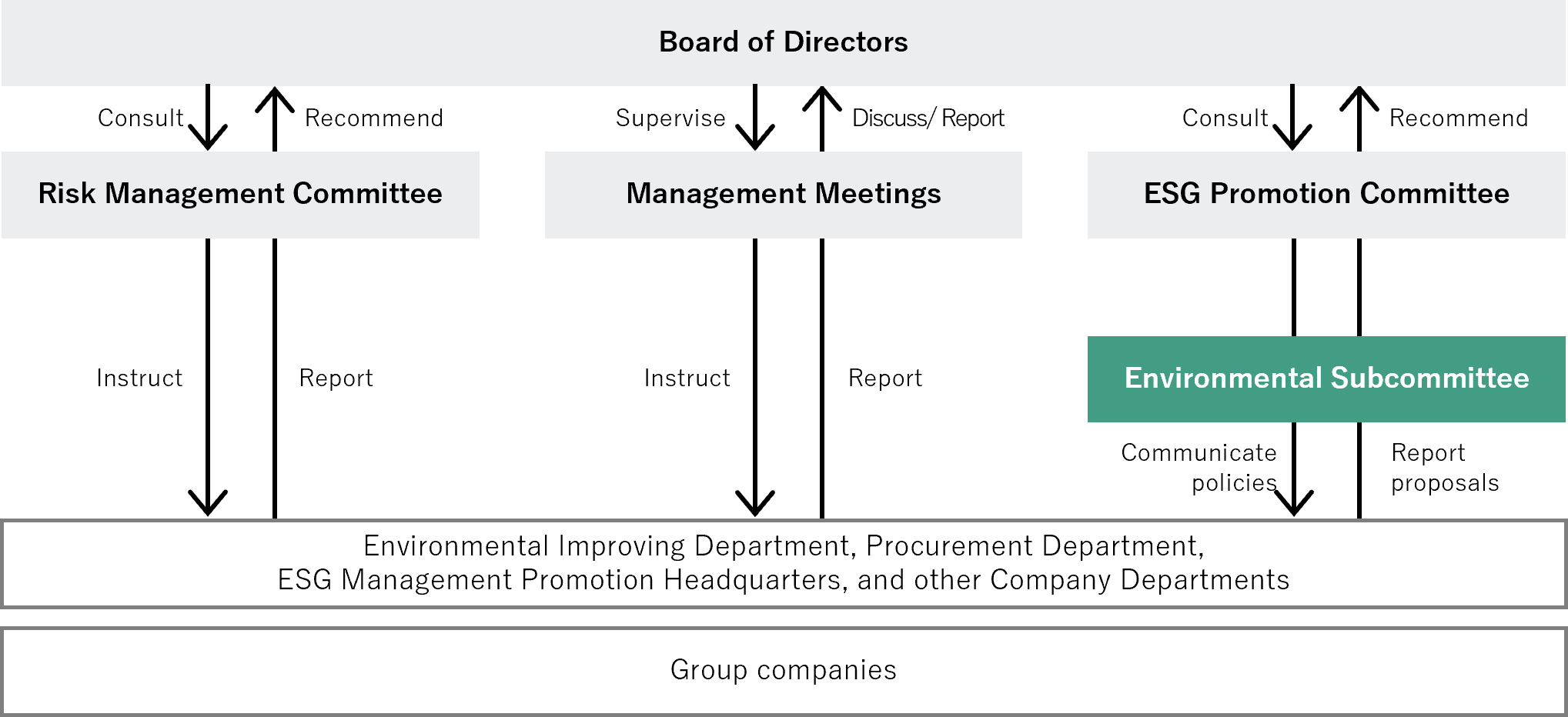
The ESG Promotion Committee ensures effective, timely management oversight by providing the director of the Board responsible for each business and other managers with routine reports and instructions on the implementation of ESG initiatives. In addition, the Environmental Subcommittee facilitates information sharing on latest findings and emerging environmental issues across relevant departments. This subcommittee also periodically reviews the validity of initiatives and targets, revising them as necessary.
Acquiring ISO 14001 certification
As part of their production process management, five domestic factories that manufacture and ship industrialized housing materials have acquired ISO 14001 certification: the Tohoku, Kanto, Shizuoka, Hyogo, and Yamaguchi Factories. One overseas factory, the Ingleburn Manufacturing and Quality Control Centre in Australia, has acquired the certification as well. ISO 14001 is the international standard for environmental management systems. We are continuing the operation of these systems, supported by internal audits and related activities.
In August 2025, we expanded the scope of certification beyond the head office and Ingleburn Manufacturing and Quality Control Centre to include all sites associated with the homebuilding business and apartment & mixed-use developments business at one of our international subsidiaries, Sekisui House Australia. This expansion enables the uniform management of safety, environmental performance, and quality based on international standards, as well as legal compliance and ongoing improvements. The company undergoes annual external audits to maintain this certification, and 100% of its production facilities are certified.
Strategy
Working to realize its global vision to make home the happiest place in the world, the Sekisui House Group aims to be a leader in ESG management that solves social issues and builds a sustainable society by promoting environmental strategies that are both advanced and have significant knock-on effects. To this end, under Sustainability Vision 2050, our long-term vision for 2050, we have set out the goals of Leading the Way to Decarbonization; Leading the Way to a Society in Which Humans and Nature Coexist, Leading the Way to a Resource-Recycling Society; Leading the Way to an Advanced, Healthy, and Long-lived Society; and Leading the Way to a Diverse Society. Under each of these, we have established targets and are advancing concrete initiatives toward their achievement.
Since announcing its Environmental Future Plan in 1999, Sekisui House has clarified the position of environmental measures within its business activities. We have pioneered the housing industry in the implementation of a variety of environmental initiatives while gaining the support of all stakeholders, including customers and the supply chain, as we expand the range and scale of our business. By examining the mutual relationships and trade-offs among a variety of environmental issues, we seek to exert a substantial positive effect on the mitigation and adaptation to climate change, biodiversity conservation, and the realization of a circular economy, etc., and to link this to future business growth.
Sustainability Vision 2050
The Sekisui House Group established the Sustainability Vision 2050 in 2016 and updated it in 2017, laying out a unified vision that encompasses the NEXT SEKISUI HOUSE 30-year Vision, which is our management policy, and initiatives to address material issues, which comprise our ESG management policy.
Sustainability Vision 2050 comprises five specific visions: Leading the Way to Decarbonization; Leading the Way to a Society in Which Humans and Nature Coexist; Leading the Way to a Resource-Recycling Society; Leading the Way to an Advanced, Healthy, and Long-lived Society; and Leading the Way to a Diverse Society. For each of these, we have set targets as challenges for 2050 as well as targets for 2030, showing how they align with the Sustainable Development Goals (SDGs).
In order to continue “Contributing to a Sustainable Society” through our business activities, we are currently exploring specific action plans aligned with our Sustainability Vision 2050.
Environmental Commitments
Following approval from the Environmental Subcommittee in June 2025, Sekisui House formulated and announced specific initiatives and policies to achieve our long-term vision for 2050: Sustainability Vision 2050.
Eco-First Promise
Sekisui House was certified as an Eco-First Company by the Japanese Minister of the Environment in June 2008 for making three promises (the Eco-First Promise) related to global warming prevention, ecosystem conservation, and resource recycling. We have been conducting environmental activities with a view to fulfilling these promises. In 2012, 2016, and 2020, we updated our Eco-First Promise within the broad frameworks of the three promises while incorporating changes in the social environment and the progress of our initiatives. In 2025, we further updated our promises to meet both the baseline requirements and Top Runner requirements designated by the Ministry of the Environment, while continuing to enhance our initiatives.
Urban Development Charter
In 2005, we established the Urban Development Charter to fulfill our responsibility to the future as a housing manufacturer. This charter summarizes the range of expertise we have cultivated as part of our urban development initiatives through the lens of sustainability. We have adopted four perspectives: environmental management, economic management, town management, and lifestyle management. We promote urban development by applying these perspectives while considering our Basic Urban Development Policy and 24 specific guidelines.
Disclosure in line with the TCFD and TNFD recommendations
The Group is committed to information disclosure in line with international frameworks including TCFD and TNFD. Recognizing the mutual relationship between various environmental issues including climate change, nature, and water, we take an integrated approach to understanding risks and opportunities and examining countermeasures. We are also moving forward with efforts to ensure compliance with the new sustainability disclosure standards, the SSBJ (Sustainability Standards Board of Japan).
Risk Management
Environment-related risks are discussed as needed by the ESG Promotion Committee and Risk Management Committee before being reported to the Board of Directors, which considers and makes decisions regarding risk mitigation, transfer, acceptance, and control. Any violations of environmental laws and regulations (including potential soil, groundwater or air pollution) are reported to the head office. Furthermore, annual inspections of one domestic factory selected based on risk analyses, are carried out by independent experts.
Metrics and Targets
The Sekisui House Group has set the following key performance indicators (KPIs) for environmental initiatives: Ratio of detached ZEH homes, ratio of ZEH units for rent, ratio of ZEH condominiums for sale, number of location-based insulation upgrades, rate of CO2 emissions reduction from new housing and similar operations, rate of CO2 emissions reduction from business activities, RE100 achievement rate, percentage of company electric vehicles (including hybrids), percentage of suppliers setting science-based targets, sustainable wood procurement rate, Deforestation and Conversion Free , biodiversity-friendly tree planting, waste rate (new construction), and waste recycling rate (maintenance and remodeling). Details about initiatives related to these KPIs are provided in the relevant sections of this report.
Promoting ZEH through Green First ZERO detached houses
Promoting ZEH in Sha Maison rental housing
Promoting ZEH in GRANDE MAISON condominiums
Environment friendly remodeling of existing houses
Promoting RE100 through Sekisui House Owner Denki
Initiatives aimed at 100% electrification of Company vehicles
Reduction of CO2 emissions at procurement stages for components and raw materials
Commitment to Biodiversity, Deforestation and Conversion Free
The Gohon no Ki Project, an eco-friendly landscaping and greening project
Wood procurement risk survey and risk assessment
Zero emissions in production and construction divisions
Compliance with environmental laws and regulations
There were no significant violations of environmental laws and regulations, including those related to soil, groundwater or air pollution, in FY2025.
| Boundary | Unit | FY2023 | FY2024 | FY2025 | |
|---|---|---|---|---|---|
| Number of significant violations(subject to punishments, administrative penalties or administrative guidance) of greenhouse gas laws and regulations or of serious leaks of fluorocarbons |
Group (Global)*1 |
Cases | 0 | 0 | 0 |
*1 Sekisui House, Ltd. and its major consolidated subsidiaries in Japan and overseas (42 companies).
Activities and Other Related Information
Environmental Charter
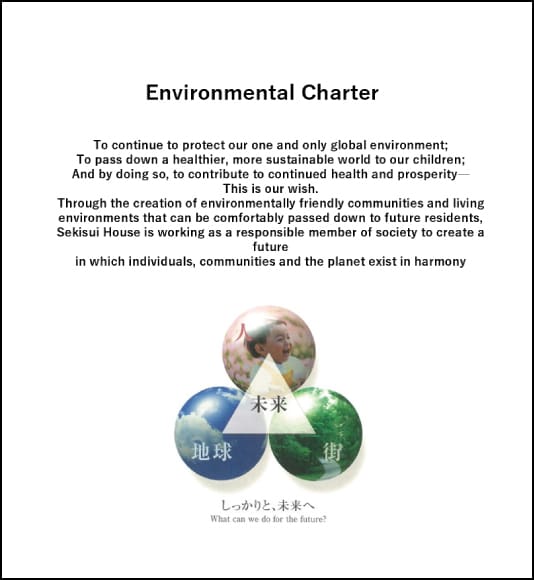
In 1999, Sekisui House announced its Environmental Future Plan, which includes the environmental charter, basic environmental guidelines, and environmental action guidelines.