[ Japanese ]
Water Security
Governance
Implementation Framework
Through the ESG Promotion Committee, the Sekisui House Group implements initiatives to address climate change–related issues, including water issues, while also considering natural capital and biodiversity conservation. Furthermore, at our factories, we have established a management system under ISO 14001, the international standard for environmental management systems, through which we are promoting water-related initiatives.
Strategy
The Sekisui House Group’s business activities, in such areas as housing, construction, and remodeling, use only small amounts of water. However, as the impacts of climate change on human society and ecosystems intensify year by year, water resources are becoming a significant global concern. In particular, over the long term, water shortages are seen as a global water risk, and the conservation of water resources, using water stress as a metric, is a challenge going forward. To secure the sustainability of water resources, we not only avoid water risk in our own businesses, but work to promote efficient water use and prevent water pollution based on the understanding that these issues have a tremendous impact on our supply chains. To this end, we assess water risks, set water use reduction targets, and implement measures to promote the effective use of water resources and manage wastewater quality.
Risk Management
Initiatives at Factories in Japan
Our five domestic production factories (the Tohoku Factory, Kanto Factory, Shizuoka Factory, Hyogo Factory, and Yamaguchi Factory) use groundwater in addition to the municipal water supply and industrial-use water in the coating of steel frame members and the manufacturing and painting of exterior walls used in residential construction. All five factories have formulated water management plans. We are making ongoing efforts to ensure appropriate wastewater quality management and the efficient use of water resources in these processes. Specifically, we implement wastewater quality analyses at least once a month and work to reduce water consumption through such efforts as reusing treated water for cleaning. Wastewater from all five factories in Japan is discharged into public sewers and rivers after being purified in the factory’s effluent treatment plant. We manage waste water quality according to voluntary standards set as annual targets that are stricter than the Water Pollution Control Law and local ordinances applicable to domestic factories. In FY2025 the measured water quality of discharge was better than these voluntary standards. In this way, we strive to prevent water pollution and protect the water quality environment in the areas surrounding our factories. We share the results of wastewater quality assessments at all five factories in Japan. In the unlikely event that our voluntary standards are exceeded, we share the information on the actualized water pollution risk at a managers’ meeting to prevent recurrences.
Evaluating Water Stress Levels at Production Sites
We have evaluated the water stress levels of the Company’s production bases using the WRI Aqueduct tools developed by the World Resources Institute (WRI). In FY2024, we revised one of the thresholds of this evaluation from “high” to “medium-high” to raise internal awareness of water resource conservation and accelerate related initiatives. Upon reevaluation, we confirmed that Kanto Factory and Shizuoka Factory fall into the “medium-high” category, while Tohoku Factory, Hyogo Factory, and Yamaguchi Factory are categorized as “low-medium.*1
*1 The Ingleburn Manufacturing and Quality Control Centre in Australia is located in a region with a high level of water stress, but the facility is not included as it does not carry out manufacturing processes that use water.
Metrics and Targets
Evaluating Water Stress Levels*2 at Production Sites
| Tohoku Factory | Kanto Factory | Shizuoka Factory | Hyogo Factory | Yamaguchi Factory | |
|---|---|---|---|---|---|
|
Production sites of the Sekisui House Group located in water-stressed areas |
○ | ○ | ○ | ○ | ○ |
| Water stress levels at production sites of Sekisui House, Ltd. | Low - Medium | Medium - High | Medium - High | Low - Medium | Low - Medium |
*2 Evaluation using the WRI Aqueduct tools developed by the World Resources Institute (WRI).
Overview of Water-stressed Areas (Medium to High)
| Boundary | Unit | FY2023 | FY2024 | FY2025 | ||
|---|---|---|---|---|---|---|
|
Number and proportion of assets, production, and revenue in water-stressed regions |
Maximum production capacity |
Shizuoka Factory | Houses/month | 800 | 800 | 800 |
| % | 29 | 29 | 29 | |||
| Kanto Factory | Houses/month | 870 | 870 | 870 | ||
| % | 31 | 31 | 31 | |||
| Water withdrawal and consumption*3 in water-stressed regions | Water withdrawal | Shizuoka Factory | 1,000㎥ | 58.7 | 69.6 | 66.9 |
| Kanto Factory | 463.4 | 411.4 | 413.3 | |||
| Water consumption | Shizuoka Factory | 1,000㎥ | 6.4 | 12.7 | 12.3 | |
| Kanto Factory | 254.9 | 195.6 | 215.4 | |||
*3 Water Consumption = Water Intake - Water Discharge
Targets for Reducing Water Consumption and Withdrawal in Water-Stressed Areas
The Company is advancing initiatives to set targets for reducing water consumption and withdrawal at our production bases, starting with those sites identified as having relatively high levels of water stress.
The Shizuoka Factory is actively working to utilize industrial-use water in processes that previously used municipal water. Furthermore, the factory has set the target of reducing the consumption of industrial-use water by 80% in its internal wastewater treatment facilities from FY2021 levels by 2030. As part of these reduction efforts, we will promote the internal circulation of water by reusing some effluent and by expanding the use of rainwater. The Kanto Factory is also taking a proactive stance on water conservation, setting targets to guide its efforts.
| Boundary | Unit | FY2023 | FY2024 | FY2025 | Targets | |
|---|---|---|---|---|---|---|
|
Reduction rate of industrial water withdrawal at wastewater treatment facilities in water-stressed areas*4 |
Shizuoka Factory | % | 93.5*5 | 22.5*6 | 38.3 |
80 (FY2030) |
*4 Reduction rate of industrial water withdrawal based on the FY2021 as the reference year.
*5 Due to some discrepancies in the reused water, the reduction rate for the next fiscal year has decreased.
*6 Starting from FY2024, the method for calculating the reduction rate has been revised.
Targets and Progress toward Reducing the Use of Water as a Raw Material
The Group does not use water as a raw material.
Investment in R&D to Mitigate Water-related Risks
Group company Konoike Construction boasts a long track record and advanced technologies in the cleanup of soil contaminated by a variety of pollutants and, in addition to soil, is working in a wide range of areas including water pollution countermeasures and disaster-related waste disposal.
| Boundary | Unit | FY2024 | FY2025 | |
|---|---|---|---|---|
| Developing water purification technologies | Konoike Construction Co., Ltd. | ¥millions | 7 | 2 |
| Development of technology to dispose of persistent substances | 44 | 54 | ||
| Enhancing existing environmental technologies (solidification and insolubilization, bio-treatment, etc.) | 10 | 3 |
For other indicators, please refer to the ESG Data Book 2026.
Other Initiatives
Cooperation with Diverse Stakeholders
Cooperation with customers
We have installed the latest water-saving fixtures (faucets, showers, flush toilets, etc.) supplied by housing device equipment manufacturers as standard equipment in the majority of the Group’s newly built houses since before 2020. In this way, we are helping to reduce water consumption in houses. Furthermore, for existing homes, we are promoting the use of water-saving fixtures, including by replacing existing fixtures, through the remodeling business.
Cooperation at business sites in water-stressed areas
The Shizuoka Factory uses municipal water drawn from the Oi River system. Based on requests from the Toen Industrial Water Business Association, the Shizuoka Factory proactively uses industrial-use water, helping to reduce municipal water consumption.
Cooperation with public entities
Group company Konoike Construction is actively involved in renewable energy projects aimed at contributing to decarbonization and is therefore working with municipalities to develop small-scale local energy distribution. We are engaged in micro hydroelectric power generation projects in Higashinada Ward in Kobe City and in Kami Town, Hyogo Prefecture. In Shimane Prefecture, we have signed a cooperative agreement with Okinoshima Town regarding the promotion of renewable energy.
In addition to launching the Minamitani Power Station for micro-hydroelectric power and the Shimonishi Power Station for biomass power in 2024, we opened the Yui Power Station for micro-hydroelectric power in 2025. Through these power generation businesses, we will contribute to the vitalization of regional communities.
Survey on the relationship between water usage at the Company’s production sites and the surrounding natural environment and biodiversity
At the five domestic factories where we are engaged in direct operations, we conducted detailed surveys to understand the characteristics of the natural environment and biodiversity conditions at water withdrawal sources (river water and groundwater) and discharge points (rivers). In doing so, we assessed the degree to which the use of water at each factory depends on and affects the surrounding natural environment. Based on the results of these assessments, we plan to investigate priority water resource conservation measures for each factory. Moving forward, we will further strengthen our water resource conservation measures, with a focus on river basins associated with withdrawal and discharge, and strive for coexistence with the local environment.
Cooperation with other regional companies
When shipping and transporting products to construction sites—whether from our own factories or those of our partner manufacturers—we use the Company’s transport cases. After use, these cases are collected from construction sites, returned to factories, washed, and reused. The water used in this washing is recirculated within the cleaning facilities, helping reduce water consumption. In addition, the employee cafeterias at some factories are operated by external food service contractors. As one part of water conservation efforts in these operations, we proactively use no-wash rice,*7 which can be cooked without additional washing.
*7 Rice that can be cooked just by adding water, without rinsing
Cooperation with investors
The management of office buildings owned by the Company and its overall real estate portfolio is entrusted to Sekisui House Asset Management, Ltd., which implements appropriate water management, including monitoring and setting numerical targets for the volume of water use.
Initiatives in overseas businesses
Located in Brisbane Australia, the mixed-use development project West Village has received high external praise for its environmentally friendly and socially sustainable initiatives. In 2017, it received the highest 6 Star Green Star Communities Certification from the Green Building Council of Australia (GBCA)*8 and in 2023 was honored with the Marketing Excellence Award for exemplary projects by the Urban Development Institute of Australia (UDIA).*9
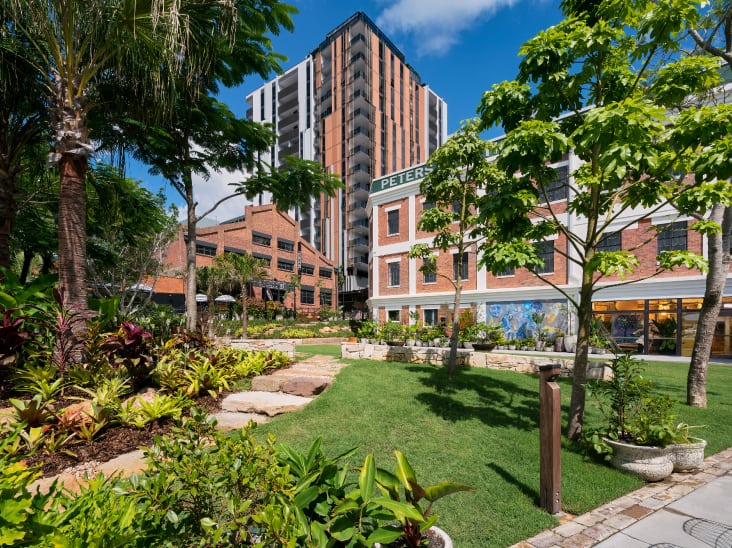
West Village comprises eight condominium buildings and nearly one hectare of green, open space, including four leafy laneways and two parks. In particular, Morrison Park, which lies within the village, incorporates nature conservation activities and historical property management initiatives. Wastewater in two of the neighboring residential buildings is treated onsite and stored in a 250 kL tank. This, together with a 50 kL rainwater tank is used to water the gardens in the park and contributes to promoting environmentally-friendly initiatives.
*8 Green Building Council of Australia (GBCA): Evaluates the sustainability of buildings, facilities, and communities through what is known as the Green Star, the largest national voluntary and comprehensive evaluation system.
*9 Urban Development Institute of Australia (UDIA): Australia’s largest real estate industry association