[ Japanese ]
Occupational Health and Safety
Basic Approach
Sekisui House prioritizes the health and safety of employees, including those of partner building constructors and construction workers, as we believe it is paramount to our daily operations. The Sekisui House Corporate Ethics Guidelines*1 and the Health and Safety Management Regulations have been established to ensure workplace health and safety, create comfortable working environments, and maintain and improve support for employee health. We request all officers to respect and uphold these standards. Additionally, the Sekisui House Association,*2 comprising Group companies involved in construction and partner building constructors, collaborates with suppliers to strive for zero occupational accidents. Our goal is to create healthy workplaces where everyone can work with safety, peace of mind, and comfort.
*1 Reorganized as the Sekisui House Group Integrity Code in February 2026.
*2 As of February 1, 2025, the association includes eight Sekisui House Construction companies under Sekisui House Construction Holdings, Ltd. (an intermediate holding company for the Sekisui House Construction Group) and around 7,000 partner building constructors (including the partner building contractors of Sekisui House Construction companies, which are members of the Sekiwa Association).
Occupational Health and Safety Management Structure
Sekisui House has established the Health and Safety Management Regulations, which lay out a health and safety management structure headed by the President (Yoshihiro Nakai, Representative Director of the Board, CEO, President, Executive Officer). For employees, the Director of the Board responsible for the Human Resources Division (Satoshi Tanaka, Representative Director of the Board, Executive Vice President and Executive Officer) oversees the system, with the Human Resources and General Affairs Department administering its operations. A health and safety committee meets monthly at each workplace to enhance occupational health and safety awareness and improve related initiatives. The committee members are diverse in terms of grade, qualifications, age, and gender. Committee discussions are communicated to employees via email and notices. Furthermore, each division and worksite annually selects a non-managerial employee as a worker representative to engage in dialogue with management.
For partner building constructors and construction workers that Sekisui House engages as a specified principal employer, the officer in charge of the Division of Technology and Production (Koya Matsumura, Managing Officer) oversees the system, with the Construction Strategy Department administering its operations. We formulate Company-wide annual health and safety plans for partner building constructors and construction workers and draw up occupational accident prevention measures as needed. To improve operational safety standards, we provide partner building constructors and construction workers with guidance and support regarding their health, safety, and employment management training.
Occupational Health and Management System Certification
One of our international subsidiaries, Sekisui House Australia, has obtained certification under ISO 45001, the international standard for occupational health and safety management, for its offices and factory (the Ingleburn Manufacturing and Quality Control Centre). In August 2025, we expanded the scope of certification beyond the head office and Ingleburn Manufacturing and Quality Control Centre to include all sites associated with the homebuilding business and apartment & mixed-use developments business. This expansion enables the uniform management of safety, environmental performance, and quality at all sites based on international standards, as well as legal compliance and ongoing improvements. The company undergoes annual external audits to maintain this certification.
This is the sole ISO 45001 certified production facility among our five domestic factories and one overseas, representing a certification rate of 16.7%.
Employee Occupational Health and Safety Initiatives
We provide health and safety education for employees as a measure to prevent occupational accidents. In the unlikely event that such an accident involving an employee occurs, the workplace where it took place promptly contacts the Human Resources and General Affairs Department, and the information is shared Company-wide through the Health and Safety Committee or other means. In addition, the Health and Safety Committee strives to prevent recurrence by conducting thorough analyses, raising awareness of health and safety, preventing unsafe behavior, and discouraging long working hours that can lead to accidents and illnesses.
Since we extensively use Company vehicles for work-related activities, the risk of traffic accidents is significant, making safe driving management and education essential. The Company has established Safe Operation of Work Vehicle Management Standards, appointing a vehicle management supervisor at each workplace and a manager at the head office responsible for comprehensive supervision. Through this structure, we are implementing thorough vehicle operation management, as well as safe driving instruction and education at each workplace. Additionally, we conduct annual traffic safety training for all employees.
Promoting traffic safety
In concert with the National Traffic Safety Campaign held in spring and fall and organized by the Cabinet Office, we implement annual traffic safety promotion activities for all employees. At worksites, employees watch videos of actual traffic accidents that have occurred at Company locations, as well as safe driving instructional videos. This is complemented by group discussions that encourage employees to learn about diverse hazard prediction approaches and techniques. These activities provide an opportunity for employees to think about actions individuals can take to promote safety. In addition to making the annual signing of pledges compulsory, we are implementing other initiatives to prevent drink-driving such as thorough sobriety checks when operating a vehicle. Through these initiatives, we promote adherence to traffic rules and encourage safe driving practices among all employees, ultimately striving to reduce the number of accidents in which they are involved.
Occupational Health and Safety Initiatives in Construction Departments
Occupational health and safety management system for construction departments
In Sekisui House’s construction departments, we have integrated the Sekisui House Zero Hazard System, which incorporates the Occupational Health and Safety Management System recommended by the Ministry of Health, Labour and Welfare while taking into account the unique characteristics of construction sites. Through this integration, we implement comprehensive health and safety management activities. To reduce occupational accidents, it is essential not only to address compliance with legal requirements and prevent the recurrence of past accidents, but also to identify and assess risk sources through risk assessments. We formulate and execute annual plans for implementing necessary measures. By respecting and passing on knowledge over the years, we aim to enhance our management tools and raise overall standards, maximizing the effectiveness of our efforts to ensure health and safety at construction sites.
To improve the efficiency of analyzing trends in accidents and incidents throughout the Company, we are systematizing our safety management processes. Specifically, we operate an accident management system to report, share, and manage information in the event of an accident, while we have also developed and operate a Safety Promotion App to systematically record findings and corrective actions during safety patrols of construction sites. Furthermore, since 2026, we have used a Construction Management App to digitally manage information related to design plan confirmation at construction sites, site management, and safety promotion documents to promote more efficient interactive management between construction contractors. Through these initiatives, we are dedicated to reducing occupational accidents at construction sites. In the event of an occupational injury or accident, the affected construction site promptly informs the Construction Strategy Department, which ensures that information is shared across the entire Company.
Announcing occupational health and safety policies
To enhance the health and safety standards at construction sites within the Sekisui House Group, we have announced the following health and safety policies:
- All individuals associated with the Company will respect health and safety-related laws and regulations, and will follow internal standards.
- All individuals associated with the Company will take personal responsibility for ensuring safety in construction activities.
- We develop construction plans that prioritize the prevention of accidents affecting the public and ensure thorough implementation and management.
Outline of Sekisui House Zero Hazard System
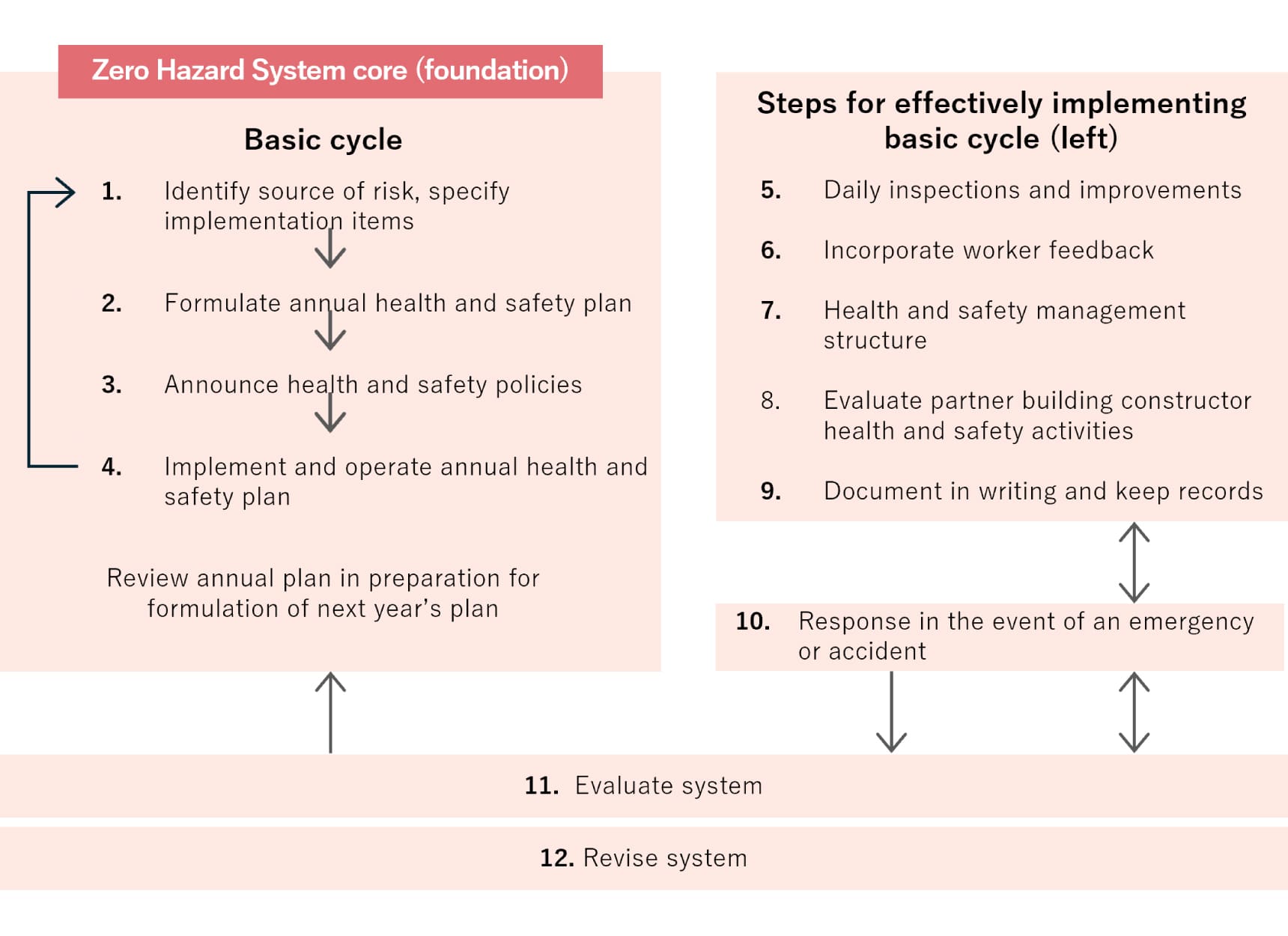
Construction site priority accident prevention themes and plan outline in FY2025
After reflecting on accidents that occurred at construction sites in the previous fiscal year, we set the following priority themes for FY2025: the elimination of falling accidents, the elimination of construction machinery/crane-related accidents, and making steady progress on and promotion of priority measures. Based on these themes, we have developed a Company-wide annual plan. To ensure safe and secure construction sites, we will continue to thoroughly implement fundamental safety activities and establish effective measures.
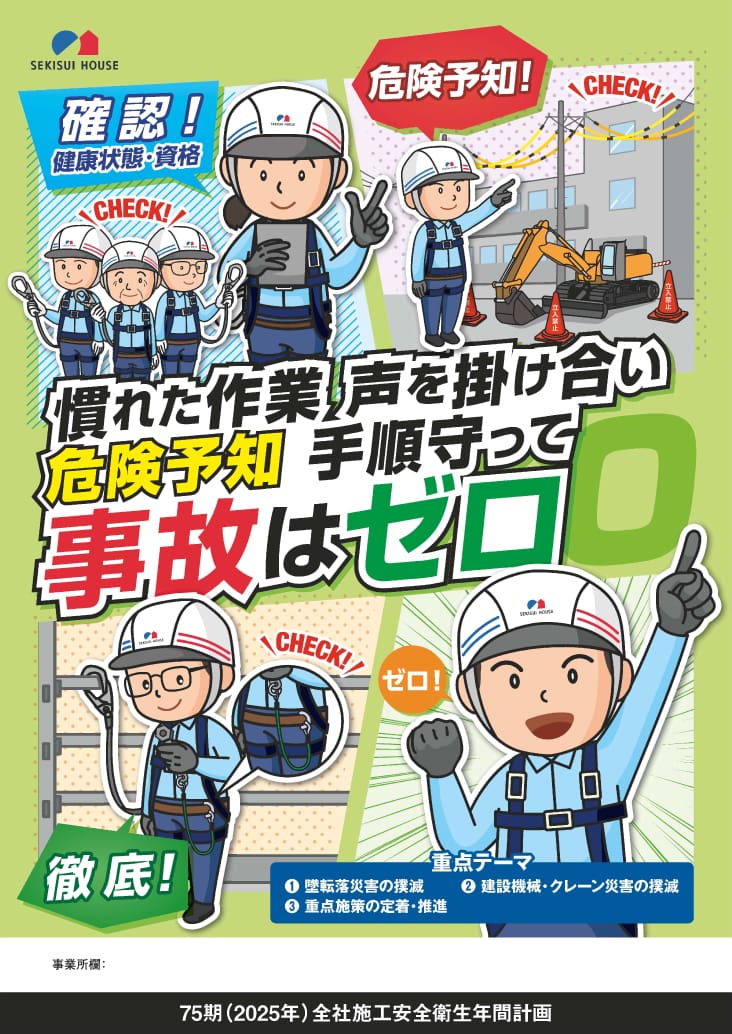
Poster of slogan for FY2025
Outline of annual health and safety plan for construction sites in FY2025
- Thoroughly enforce adherence to countermeasures against serious accidents (accidents that could potentially be fatal), such as falls.
- Implement safe construction standards, create operational plans, and offer thorough guidance to prevent loss of life or major damage caused by the overturning of construction machinery and cranes and their contact with structures or people.
- Ensure all construction workers carry cut-resistant gloves and wear them at appropriate times to eliminate laceration and puncture accidents caused by tools and materials.
Reflecting on specific initiatives regarding key themes
Elimination of falling accidents
- Strengthening onsite training and instruction: Recognizing that falling accidents can lead to serious injury or death, we enhanced our onsite training and instruction programs.
- We have begun the factory-based leasing of fall protection barriers to prevent falls near elevator shaft openings.
- We strove to adhere to thorough instructions regarding the proper use of stepladders and portable workbenches as a preventive measure against falls.
- We conducted a special joint training program for those working at height on the use of full-body harnesses. The aim was to educate workers on proper use to ensure operational safety and prevent accidents from occurring.
Elimination of construction machinery/crane-related accidents
- We created operational plans for mobile cranes and confirmed 100% implementation of onsite displays.
- We implemented nationwide slinging training and reinforced our guidance system by equipping construction section workers at all worksites with expertise in crane operation.
Making steady progress on and promotion of priority measures
- Results of an analysis on the causes of laceration accidents confirmed the efficacy of cut-resistant gloves, and we created environments where construction sites could be properly equipped with and utilize such gloves.
- To prevent objects from falling, we aimed for thorough recurrence prevention by promoting the use of tool lanyards among workers on scaffolding, where the risk of objects falling is high.
Initiatives to share general information on accidents
- We digitized the KY (Kiken Yochi)*3 process in December 2024 and began full-scale operation in 2025. By conducting mutual confirmation between supervisors and workers using smart devices, we worked to prevent the formalization of KY activities.
- We incorporated safety video viewing into the digitized KY system, enhancing our accident prevention efforts by requiring employees to watch these videos before beginning work.
- We promoted the spread of safety education activities which focus on interactive dialogue through remote safety meetings that utilize smart devices.
*3 A shortened version of “kiken yochi,” a Japanese expression meaning “danger prediction.” This involves the prediction and estimation of potential causes of danger during work operations.
Occupational health and safety training at construction sites
To strengthen the Company-wide safety management system, we conducted safety training for around 2,400 onsite managers at locations nationwide to further improve their understanding of laws and regulations and safety standards. In this training, in addition to confirming understanding of laws and regulations among management-level employees and the level of safety management conducted at construction sites, we work together to unify management systems across Japan. This initiative aims to both boost safety awareness and establish the relevant expertise. We will continue with training moving forward to build an even more robust safety management system.
Assessing safety risks related to construction sites
Sekisui House’s business operations involve the use of heavy machinery and work performed in heights, which increase the potential for fatal accidents. Therefore, we conduct thorough site inspections at each business location for all new projects for which we receive orders. In addition to planning construction in accordance with manuals and assessing risks related to the safety of construction workers, we also evaluate the impact on local residents in compliance with Japanese laws from the planning stage.
Occupational Health and Safety Management Initiatives
As a part of internal audits related to occupational health and safety, the Company conducts technical audits (safety reviews) at all 95 of its worksites. Taking the place of the previous special safety audits that were implemented in reaction to serious accidents or infractions, these technical audits began in 2025 to shift to a preventive management approach, aiming to prevent accidents from occurring through thorough construction site safety management.
- Reinforcement of safety management: Thorough prevention of occupational accidents by checking onsite risk reduction measures and suggesting improvements.
- Establishment of safety awareness: Development of a safety-first culture at construction sites through audits and promotion of continuous improvements.
Through these initiatives, in addition to enhancing the transparency of our governance, we are strengthening our social responsibility to ensure safety and quality.
Occupational health and safety initiatives at Konoike Construction
As part of its commitment to occupational health and safety, Konoike Construction, a Group company, has maintained certification under the Construction Occupational Health and Safety Management System (COHSMS) at all its offices since 2014. Striving to eliminate accidents, Konoike Construction conducts regular internal audits of construction sites, safety patrols, and provides health and safety education for its employees as well as the management and workers of partner companies.
Collaboration with Sekisui House Association
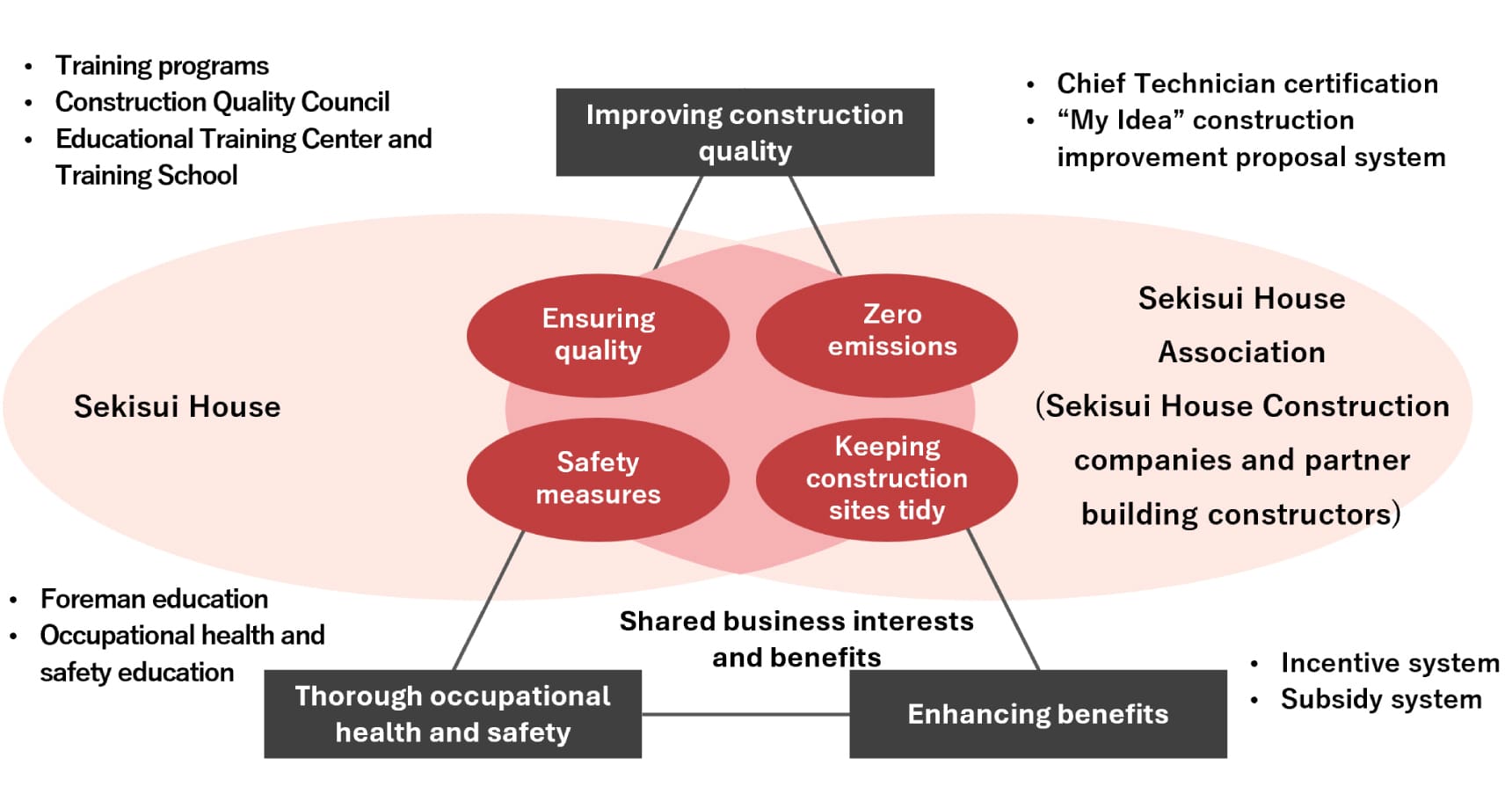
The greatest strength of the Group is the Sekisui House Association, which consists of Group companies involved in construction and partner building constructors. Since its founding, Sekisui House has practiced a responsible construction system. Our partner building constructors are invaluable assets, and we hold them in high regard, nurturing long-term relationships based on trust and mutual interest in the spirit of a “community with a common destiny.” To achieve customer satisfaction, the Sekisui House Association cooperates with each Sekisui House office to implement various initiatives. These initiatives focus on safety measures, improving construction quality, providing solutions for customers and neighbors, achieving zero emissions, keeping construction sites tidy, developing human resources, and improving working conditions. Moreover, the association serves as a platform for information exchange, allowing individual construction sites and partner building constructors to share issues they face and collaboratively explore potential solutions. The association also provides training and educational opportunities aimed at improving work processes and construction quality. In times of natural disaster, such as when an earthquake or flood strikes, the Sekisui House Association plays a crucial role in facilitating action, from initial response to restoration and reconstruction efforts. We are committed to continuing our collaboration with the association to enhance customer satisfaction and elevate the value of the Sekisui House brand, striving for coexistence and co-prosperity as “a community with a common destiny.”
Achieving Customer Satisfaction with the “Community with a CommonDestiny” Mindset
Onsite safety patrols (including contractor sites)
To prevent accidents, Sekisui House conducts regular safety patrols at worksites. These patrols check that construction is being carried out in accordance with our safety standards and are performed not only by Sekisui House’s onsite managers, but also by contractors. By involving construction contractors in these patrols, we aim to go beyond merely issuing one-sided corrections and directions to foster a more substantive understanding of our health and safety standards.
Occurrences of Occupational Accidents
The number of fatalities among Sekisui House employees over the past three years was zero. For contractor in Sekisui House construction departments, there was one fatality due to occupational accidents in FY2023 (due to heat stroke), zero in FY2024 and FY2025. The lost time injury frequency rate for the Group*4 was 0.82 in FY2025. In contrast, the lost time injury frequency rate for contractors of the Sekisui House Group*5 construction departments improved to 1.99 from the previous year. We will continue to develop annual plans and strengthen our initiatives to achieve zero occupational accidents
*4 Sekisui House, Sekisui House Real Estate Group, Sekisui House Construction Group, Sekisui House Remodeling, Konoike Construction.
*5 Sekisui House, Sekisui House Construction Group,(noie business), Konoike Construction.
| Targets | Boundary |
Lost time injury frequency rate (resulting in one or more days of lost worktime) |
Occupational illness frequency rate (resulting in one or more days of lost worktime) |
|||||
|---|---|---|---|---|---|---|---|---|
| FY2023 | FY2024 | FY2025 | FY2023 | FY2024 | FY2025 | |||
| Employees | ||||||||
| Administration |
Group (Japan) |
0.21 | 0.16 | 0.83 | 0.11 | 0.02 | 0.04 | |
| Production | Sekisui House, Ltd. | 0.00 | 0.00 | 0.44 | 0.00 | 0.00 | 0.00 | |
|
Total for employees (Administration) |
Group (Japan) |
0.20 | 0.15 | 0.82 | 0.10 | 0.02 | 0.04 | |
| Contractors | ||||||||
| Production | Sekisui House, Ltd. | 1.63 | 0.96 | 0.96 | 0.00 | 0.00 | 0.00 | |
| Construction | Sekisui House, Ltd. | 2.87 | 2.95 | 2.29 | 0.53 | 0.62 | 1.02 | |
|
Group (Japan) |
2.37 | 2.49 | 1.99 | 0.42 | 0.53 | 0.92 | ||
Calculation standards:
Lost time injury frequency rate: Number of fatalities and injuries per million working hours due to lost work-time injuries
Occupational illness frequency rate: Number of occupational illnesses per million working hours
Targets:
- Employees, excludes part-time workers.
- Construction department contractors, includes sole proprietors and employers.
Boundary:
- Group employees (Japan): FY2023, employees of Sekisui House and Sekisui House Real Estate Group; for FY2024, employees of Sekisui House and major domestic Group companies (excluding Konoike Construction) ; for FY2025, employees of Sekisui House and major domestic Group companies.
- Contractors in Group construction departments (domestic): Up to FY2024, Sekisui House, Sekisui House noie, Konoike Construction; for FY2025, following the organizational restructuring of Sekisui noie, the scope includes Sekisui House, Sekisui House Construction (noie business), and Konoike Construction.
Total working hours:
- Employees and contractors (production department): Calculated based on actual working hours.
- Contractors (construction department) for Sekisui House, Ltd. and Sekisui House Construction (noie business) Sekisui House noie: Calculated as eight hours per person per day. Additionally, for contractors (construction department) involved in the TOKKEN Building Business*6 of Sekisui House, Ltd., calculation were based on actual working hours starting from FY2024.
- Contractors (construction department) for Konoike Construction Co., Ltd.: Calculated as nine hours per person per day
*6 Construction business involving conventional building methods, including reinforced concrete structures
Industry Average Rates of Occupational Accidents
| Occupational accident rate | FY2022 | FY2023 | FY2024*7 | |
|---|---|---|---|---|
| General contractors | 1.47 | 1.69 | 1.91 | |
| Contracted amount of business | ¥1 billion or more | 1.22 | 1.48 | 1.66 |
|
¥500 million to less than ¥1 billion |
2.49 | 2.39 | 2.28 | |
| Less than ¥500 million | 1.89 | 1.88 | 2.32 | |
Source: Ministry of Health, Labour and Welfare, “Survey of Industrial Accidents”
*7 Data is presented up to FY2023, as figures for FY2024 have not yet been released as of the publication of this report.
Number of Deaths
| Targets | Boundary | FY2023 | FY2024 | FY2025 |
|---|---|---|---|---|
| Employees |
Group (Japan)*8 |
0 | 0 | 0 |
| Construction department contractors*9 | Sekisui House, Ltd. | 1 | 0 | 0 |
*8 Sekisui House and domestic consolidated subsidiaries.
*9 Includes sole proprietors and employers.
Occupational accidents at construction sites and responses
- In FY2025, the number of occupational accidents at construction sites resulting in one or more lost worktime decreased to 76, representing 76% of the previous fiscal year.
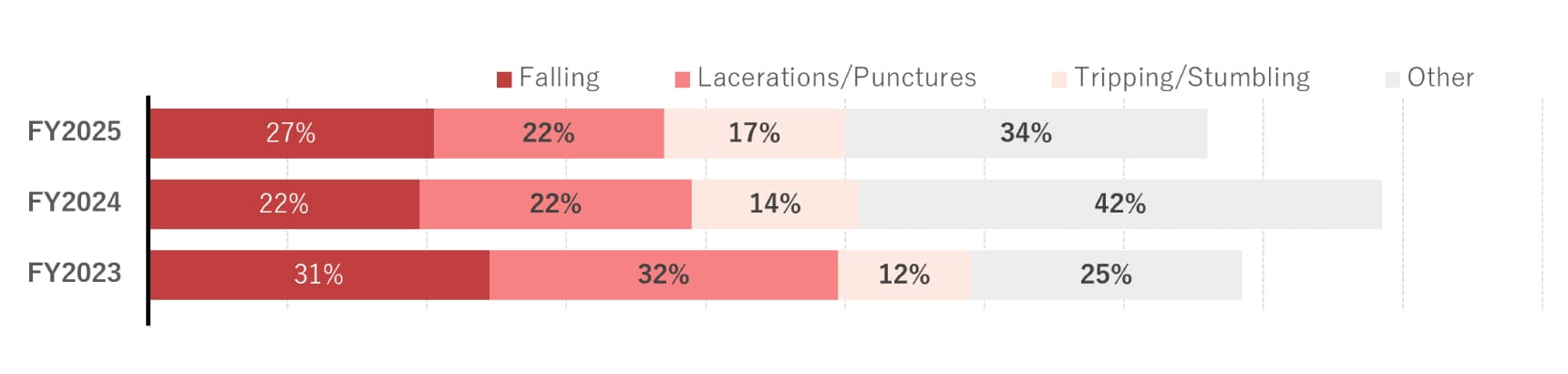
- Falling accidents, tripping and stumbling accidents, and accidents involving lacerations or punctures accounted for 70% of all accidents. The first two categories typically result in prolonged time off from work. Therefore, we have implemented measures focusing on the key themes of proper use of stepladders, where occurrences of falls are high, and ensuring safe pathways to prevent tripping and stumbling.
- For the issues of falling accidents, we implemented an awareness-raising campaign to strengthen the elimination of stepladder/portable workbench accidents by spreading awareness and establishing measures against such accidents. We sought to promote appropriate use of stepladders and portable workbenches using the slogans “That’s dangerous, stop using it that way. Three major accident risks: Speak up with courage to protect lives.
- Although the number of incidents of heat stroke (including those not resulting in lost worktime) rose to 113% of that in the previous fiscal year, 90% of these incidents resulted in three days or less of lost worktime. To reduce the number of incidents, and in accordance with amendments to the relevant law in June 2025, in addition to strengthening our internal management structure, we are also promoting the “cool site project” in line with recent weather circumstances. Specifically, we are working to improve onsite working environments through the use of window air conditioners and air-conditioned break booths.
Occupational Accidents at Construction Sites*10
| Number of Cases | Targets | Boundary | Unit | FY2023 | FY2024 | FY2025 |
|---|---|---|---|---|---|---|
| Construction site accidents (excluding heat stroke) | Construction department contractors*11 | Sekisui House, Ltd. | Cases | 97 | 100 | 76 |
| Heat stroke | 18 | 21 | 34 |
*10 Total numbers of accidents resulting in one or more days of lost worktime.
*11 Contractors of Sekisui House (including sole proprietors and employers)
Occupational Accidents at Construction Sites by Type (including those not resulting in lost worktime, excluding heat stroke)