[ Japanese ]
Supply Chain Management
Basic Approach
Sekisui House is committed to socially and environmentally responsible CSR procurement with the aim of contributing to a sustainable society, including the entire supply chain. Our purchasing policy is based on fairness, impartiality, and relationships of trust, and combines the provision of the best quality, robust delivery, and reasonable prices, while incorporating ESG promotion.
To effectively work on CSR procurement initiatives, including human rights, labor practices, and decarbonization within the supply chain, it is essential to expand our engagement efforts from our suppliers to their suppliers and beyond. To achieve this, in addition to monitoring our suppliers, we also focus on creating engagement activities such as briefings and drive these initiatives forward alongside them.
QDC plus ESG
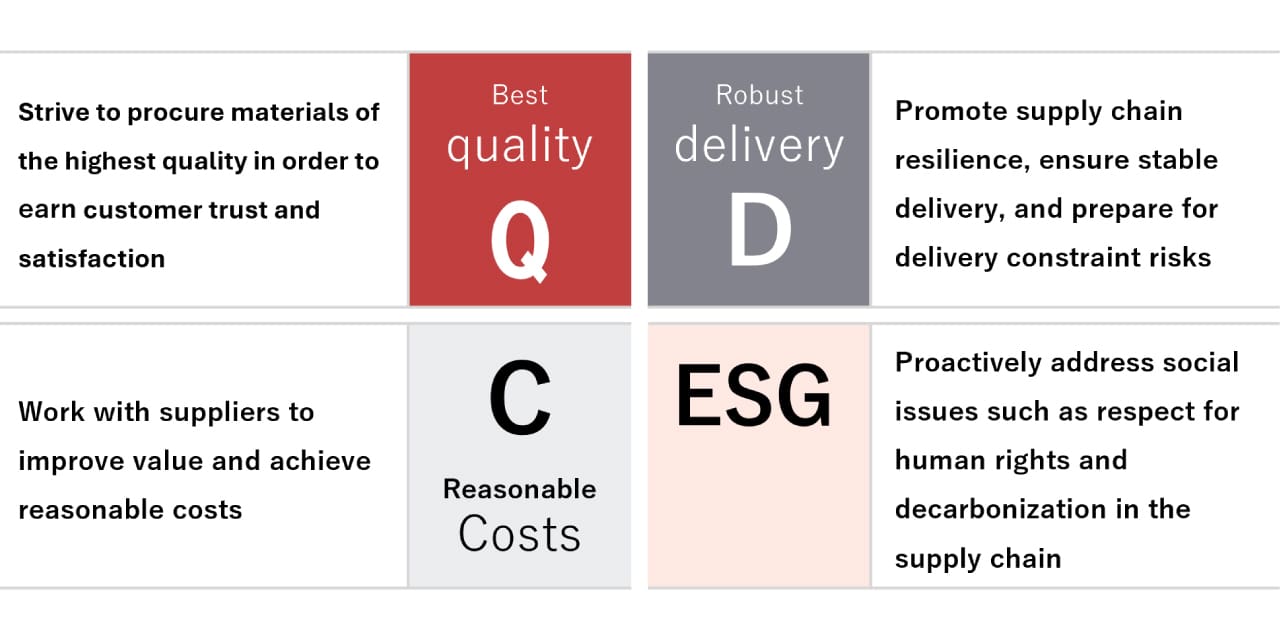
Structure for promoting the supply chain
The ESG Promotion Committee has designated social and environmental issues in the supply chain as priority areas. Human rights, labor, and other related issues are discussed at the Human Rights Due Diligence Meeting under the Social Improvement Subcommittee, while issues such as decarbonization and wood procurement are discussed by the Environmental Subcommittee, and initiatives are rolled out as necessary.
Supply chain management is conducted through mutual cooperation among all related departments under the supervision of the officer in charge of the Division of Technology and Production. The procurement department works to enhance suppliers’ understanding and awareness of key ESG issues and business continuity planning (BCP) in quality and supply, by holding annual activity policy briefing sessions and various study sessions. When hosting study sessions, we strive to communicate consistent messages as a company through thorough discussions with specialized departments responsible for the environment, human rights, and other areas.
Moreover, procurement staff can refer to guidelines and other regulations at any time. Additionally, we are promoting continuous improvements through seminars and working groups to ensure efforts are aligned with the latest laws and social issues.
PDCA Practice for CSR Procurement
Upon signing the United Nations Global Compact in 2018, Sekisui House joined the supply chain subcommittee of the Global Compact Network Japan (GCNJ). We established the CSR Procurement Guidelines*1 for our suppliers, which are compliant with the GCNJ’s self-assessment questionnaire (SAQ). Since then, we have asked suppliers to submit a signed agreement to confirm their understanding and compliance with the purpose and content of the guidelines, as well as cooperation with periodic checks or audits regarding their efforts. We explain the significance and importance of CSR procurement to our suppliers at our annual activity policy briefing sessions held each Spring.
In addition, at the end of each year, we conduct a CSR evaluation using a self-assessment check sheet based on the GCNJ’s SAQ, in order to confirm compliance with the guidelines. By implementing the PDCA cycle for CSR procurement with these initiatives, we are raising awareness of social responsibility among our suppliers and deepening CSR procurement. Even when commissioning new suppliers, we perform evaluations based on internal regulations to confirm the company’s suitability in terms of ESG and other factors. We also require new suppliers to sign and submit a written confirmation acknowledging their understanding of the purpose and content of the CSR Procurement Guidelines before any transactions are conducted.
*1 The guidelines comprise nine items conforming to GCNJ version of SAQ: (1) Corporate Governance; (2) Human Rights; (3) Labor; (4) Environment; (5) Fairness; (6) Quality and Safety; (7) Information Security; (8) Supply Chain; and (9) Coexisting with Local Communities.
Conducting annual activity policy briefings for suppliers
The Company holds an annual activity policy briefing for our suppliers to promote CSR procurement. The purpose of the briefing is to deepen the understanding of suppliers regarding our procurement activities, and approximately 220 major suppliers participated in FY2025. The aim is to promote understanding of the Company’s procurement activities. In addition to requesting that suppliers understand and comply with the objectives and content of the CSR Procurement Guidelines, we also explain specific procurement initiatives.
Moreover, alongside sharing examples of improvements made by suppliers and honoring outstanding suppliers, we also provide feedback on CSR evaluations and host lectures by external experts that raise awareness of ESG issues.
Activities to strengthen collaboration
We are expanding activities to strengthen our collaboration with key suppliers to promote a common understanding of priority issues, align the directions of activities, and drive major reforms and improvements. In FY2025, we carried out activities in these areas with 10 companies.
Supply chain policy on social issues
We recognize “human rights and labor” as one of the most important social issues in our supply chain. The Sekisui House Group Human Rights Policy applies to all officers and employees of the Sekisui House Group. We also expect our business partners, including partner building constructors and suppliers, to understand and support this policy. The policy is available on our official website, while we also promote awareness and encourage compliance among suppliers through briefings and other means. The CSR Procurement Guidelines prohibit discrimination based on nationality or race, inhumane treatment, forced or compulsory labor, and child labor. They also require appropriate management of employee health and safety. We obtain signed agreements from our suppliers indicating that they understand the purpose and content of the guidelines.
Initiatives respecting human rights in the supply chain
In order to promote respect for human rights in the supply chain, we believe it is essential to expand the circle of engagement from our suppliers to their suppliers. Each year, we implement various initiatives to this end.
<Initiatives by fiscal year>
FY2022: We held a study session with external experts, which was attended by 150 suppliers, improving awareness of human rights and equipping participants with fundamental knowledge. Furthermore, in September that same year, in response to the establishment of the Guidelines on Respecting Human Rights in Responsible Supply Chains by the Japanese government, we surveyed 360 of our suppliers about their efforts to establish human rights policies and publish these.
FY2023: Based on survey results, we hosted a study session with 157 suppliers and Sekisui House procurement staff to deepen their understanding of Japanese government’s guidelines.
FY2024: We hosted a study session for 279 suppliers on practical points of the guidelines.
FY2025: We hosted a study session for 471 suppliers on “human rights as an essential part of corporate management”.
The Company procurement staff also participate in these study sessions to improve their practical knowledge. Moving forward, in addition to ongoing efforts to ensure respect for human rights throughout the supply chain, we will continue to host study sessions as a platform for training on social issues.
Supplier Monitoring
The CSR evaluation is conducted using a self-assessment checklist based on GCNJ’s version of SAQ. Suppliers are asked to self-evaluate their own initiatives in nine areas, including corporate governance, human rights, and labor, from five perspectives: ①awareness of laws, ②policies, ③systems and responsibilities, ④confirmation of results of initiatives, and ⑤corrective actions. The results are then scored and evaluated.
When risks related to areas such as the environment or human rights are identified through CSR evaluations of existing suppliers, we designate such suppliers as requiring close attention and conduct monitoring through web-based methods or on-site visits. Through this monitoring, we provide advice on evaluation criteria and achievement levels and confirm actual conditions, thereby carrying out due diligence. If a significant risk is discovered, the Company will take appropriate action in consulting with relevant departments and stipulate measures such as reduction of transactions based on the supplier evaluation score. Targets of CSR evaluations are selected in order of highest to lowest volume of transactions, covering over 95% of total procurement spending by major business partners. As of the end of 2025, we conducted CSR evaluations of 190 suppliers and determined that five suppliers should be monitored in terms of human rights, four in terms of labor, and five in terms of the supply chain (with overlap). We are monitoring each company to promote improvement.
| KPI | Boundary | Unit | FY2023 | FY2024 | FY2025 | Targets |
|---|---|---|---|---|---|---|
| CSR procurement human rights, labor, and supply chain scores |
Sekisui House, Ltd. |
points | 88.3 | 89.0 | 87.8*2 |
86.0 (FY2025) |
*2 Expanded scope of major suppliers in FY2025
Additionally, as a construction company, we consume a large volume of wood and recognize the need for especially strict wood procurement. For this reason, we implement an annual wood procurement risk survey of about 60 major wood building material suppliers. Furthermore, when necessary, we conduct onsite inspections both domestically and internationally, including visits to logging areas at the most upstream portion of the supply chain. In FY2025, approximately 60 companies were surveyed, and on-site inspections were conducted at logging sites and wood suppliers in Thailand, Vietnam, and Malaysia.
Risk assessment of social issues
Since FY2021, we have required suppliers to report violations of laws and regulations in addition to answering each question in the CSR evaluation. This approach complements the CSR evaluation results and enables us to identify high-risk suppliers who may be in violation of compliance, allowing for prompt action to be taken.
In FY2025, we received three reported cases, all of which were resolved appropriately in accordance with guidance from governmental authorities, with no compliance violations being identified. Additionally, no high-risk suppliers were determined during this assessment.
Enhancing Sustainable Procurement
Promoting business continuity planning (BCP)
We have long collaborated with our suppliers to establish an initial response communication system for natural disasters and conduct related drills. However, in recent years, previously unanticipated procurement risks have become increasingly frequent, including not only natural disasters and industrial fires, but also global semiconductor and raw material shortages, geopolitical risks, and cyberattacks.
To address a broad range of these risks, we held the Supply Chain Resilience Promotion Conference, with approximately 160 suppliers participating in September 2021 and around 260 suppliers in September 2022. Strengthening the supply chain necessitates expanding the engagement from our suppliers to include their respective suppliers as well. During the conference, we outlined our activities to strengthen BCP and shared specific examples from our suppliers to raise awareness. Furthermore, since FY2023, we have been mapping the impacts of supply risks and clearly defining targets to improve the efficacy of our activities.
In response to the recent global increase in cyberattacks, we conduct events such as information security training sessions for our suppliers. We are committed to monitoring and addressing various procurement risks to maintain and develop a robust and resilient supply chain.
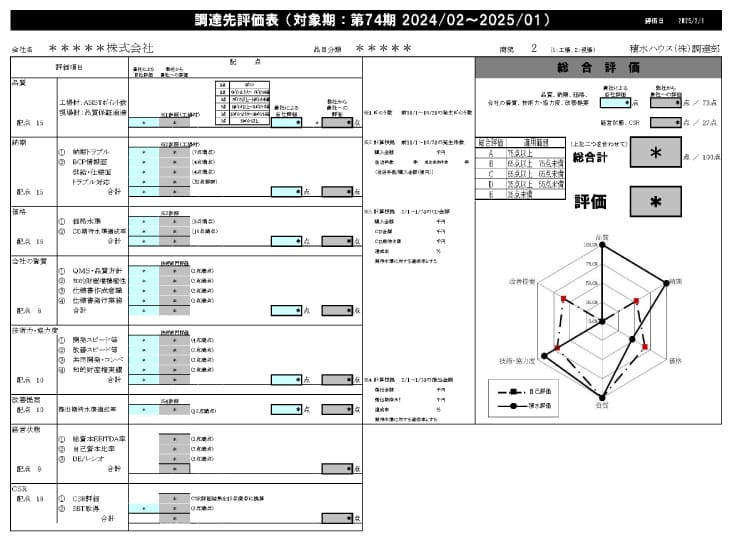
Supplier assessment chart (sample)
Process improvement through supplier assessments
To ensure fair and impartial transactions, we conduct supplier assessments that evaluate factors such as Quality, Delivery, and Cost (QDC), as well as technical capabilities. The CSR evaluation is included as one of the supplier assessment criteria. We disclose the assessment results to the relevant suppliers to facilitate improvements and strengthen their internal structures. In conducting these assessments, we emphasize process management to encourage reforms rather than relying solely on uniform evaluations of the results.
In FY2025, the supplier assessments covered 140 companies, representing 76.2%*3 of total procurement spending. Moving forward, we will continue to implement highly transparent supplier assessments and support the strengthening of suppliers’ frameworks while maintaining fair and impartial transactions.
*3 Percentage of suppliers covered by assessments relative to all suppliers (by purchased value; trading companies are not included in these assessments)
Declaration of Partnership Building
In November 2022, Sekisui House participated in the Declaration of Partnership Building initiative established by the Japanese Cabinet Office. This initiative involves representatives of companies that contract out work formally declaring to commit to coordinate and promote coexistence and co-prosperity with business partners and value-creating contractors within the supply chain, thereby building new partnerships. To date, nearly 88,000 companies have made declarations.
Under this declaration, each company posts the following information on a dedicated portal site.
- Commitment to coexistence and co-prosperity throughout the supply chain, fostering new partnerships that transcend scale and business affiliations.
- Compliance with preferred business practices between contractors and subcontractors, adhering to the “promotion standard” based on the Act on the Promotion of Subcontracting Small and Medium-sized Enterprises.