[ Japanese ]
Initiatives to Realize a Circular Economy
Governance
Implementation Framework
Under the ESG Promotion Committee, the Sekisui House Group has set up a Resource Recycling Task Force within the ESG Management Promotion Headquarters to build and administer a system for resource recycling for the entire Group. To maintain advanced resource recycling procedures, we created the Sekisui House Zero Emissions System based on the Wide Area Certification System. We also set up our own facilities, called Resource Recycling Centers, to consolidate waste generated at construction sites and ensure reliable recycling. To support this system, we created a waste sorting guide for resource recycling as well as guidelines that set out the criteria for selecting recycling companies. We are distributing information on these measures to our employees and partner building contractors, and we have developed and operate our own waste collection and waste measurement systems. In this way, we centrally manage all processes from waste generation to recycling.
In addition to using recycling methods, the Resource Recycling Task Force also coordinates related resource recycling activities that help develop a circular economy, including through our product development and manufacturing departments.
Strategy
Resource circulation guidelines
Our basic guideline is to sustain an advanced resource recycling system based on the Sekisui House Zero Emissions System.
Basic policy for zero emissions
- This system is designed to control waste generation throughout the entire supply of pre-fabricated housing by analyzing the state and nature of waste generation and continually providing information useful for reducing waste during design, production, and construction.
- This system, which establishes standards for treatment consigned to others and ensures effective treatment contracting based on those standards, is also designed to withstand future improvements in social standards.
Priority items
・Ensure effective recycling processes
・Ensure traceability
・Implement complete sorting of waste within the Company - Operations follow the Wide Area Certification System, in principle, as a basis for fulfilling the above norms.
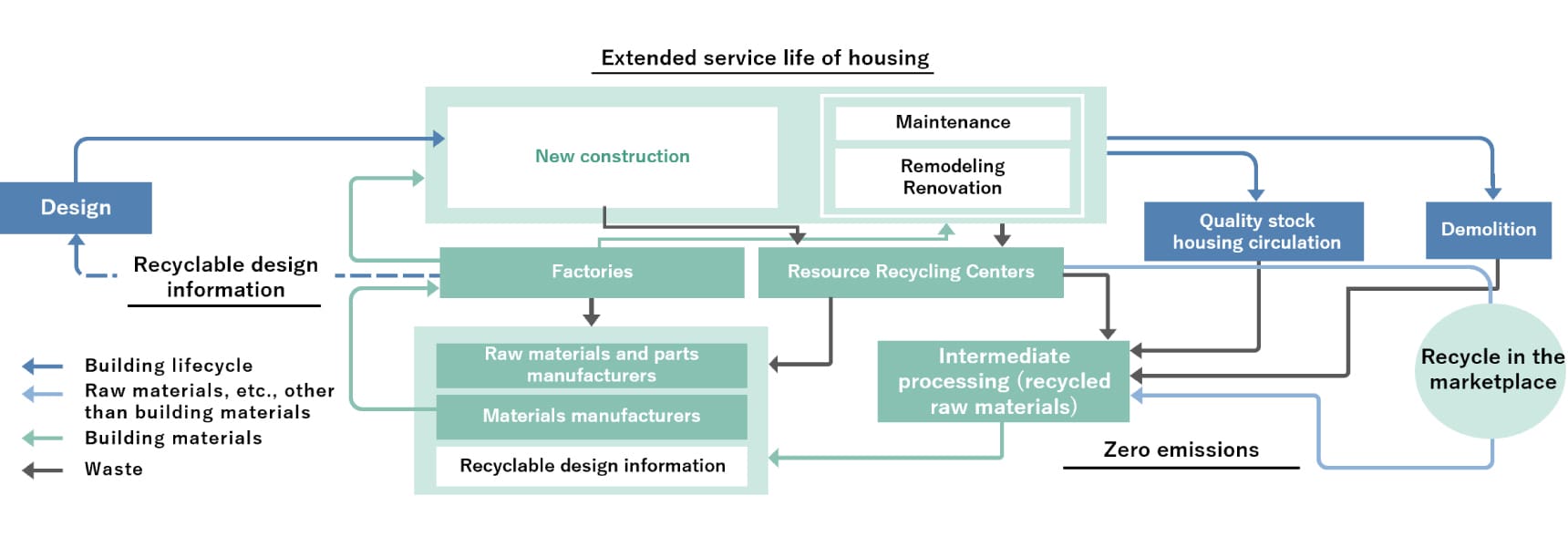
Resource Circulation Graphic
Measures and commitments to reduce resource use
The Sekisui House Group works to reduce resource use based on three approaches.
- Through zero emission initiatives, we are working to recycle and make effective use of waste from construction sites, with a focus on material recycling.
- We strive to improve durability and provide after-sales services and remodeling in step with the lifecycle stages of housing. These efforts help to extend the service life of housing and reduce resource use.
- We aim to realize a circular economy through research and development of new building materials using recycled resources
Measures and commitments for resource use at factories
To effectively utilize byproducts resulting from the production of factory manufactured components, we recycle such byproducts by processing and converting them into raw materials. For example, we have adopted equipment for recycling scraps generated during exterior wall panel manufacturing and the cutting of holes for pipes to pass through, turning them back into raw materials for exterior walls.
Measures and commitments for handling waste
Controlling waste generation
We have focused efforts on the development of systems intended to control waste generation. We analyze the amount of resource inputs that go into product supply as well as the status and nature of waste generated during the manufacturing and construction processes. We also continuously improve systems for providing information useful in reducing waste in the processes of design, production, and construction.
Utilizing waste
We establish recycling standards for the waste we generate and ensure proper recycling in accordance with these standards. Moreover, we will continue to pursue recycling technologies that are economically feasible while further contributing to the emergence of a society committed to resource recycling. We will pursue these goals in collaboration with our partner companies, including material manufacturers, factory production companies, partner building constructors, intermediate processing companies, and demolition companies.
Basic program for increasing the resource usage rate
We are working to maintain resource efficiency-conscious product design that minimizes the generation of unused materials (waste), regardless of changes in material inputs required to enhance housing functionality (such as improving durability, thermal insulation, and the flexibility of living spaces).
Product requirements of the Green Procurement Policy
We are committed to green procurement, seeking to fulfill our social responsibility under our basic purchasing policy of providing the best quality, robust delivery, and reasonable prices while also incorporating ESG Risk Management considerations. Through such efforts as working with suppliers to develop and procure products that are easy to separate and sort for recycling, the Company prioritizes choosing environmentally friendly products and services in our procurement efforts that contribute to sustainability. For example, to facilitate the sorting of hot water pipe scraps, we do not use adhesives to bond double-layered hot water pipes when the layers are made from different types of plastic.
Circular Design from “House to House” project
To drive the transition to a circular economy in the housing industry, we have declared our commitment to achieving homebuilding using only recycled materials by 2050 through the Circular Design from the “House to House” project. We will aim to review all components to ensure they are recyclable and contribute to the effective use of resources and the reduction of waste. Through collaboration with suppliers and universities, we are developing products using recycled resources and analyzing our reuse of each material. By building a secure supply system and aiming for sustainable resource use, we hope to be able to contribute to greater resource security and decarbonization.
Risk Management
Addressing resource recycling risks
When formulating the Sekisui House Zero Emissions System, the Group focused on building a system that takes into account certain risks in resource recycling, such as fraudulently passing off non-recyclable waste
as recyclables and illegal dumping. In addition to selecting recycling companies based on the guidelines from our selection criteria, we periodically inspect treatment centers, perform operational audits, and (on an ongoing basis) manage consignment contracts and waste management manifests through a centralized in-house management system. Through these efforts, we work to minimize (avoid) potential risks. A dedicated department at the head office is ready to take immediate action in the unlikely event that a potential violation of laws and regulations is detected.
Metrics and Targets
| Boundary | Unit | FY2023 | FY2024 | FY2025 | Targets | ||
|---|---|---|---|---|---|---|---|
| Waste rate (new construction)*1 | Sekisui House, Ltd. | % | 5.9 | 6.0 | 6.1 | ー | |
| Raw material and resource input | 1,000t | 820 | 781 |
741 |
ー | ||
|
Waste from new construction (factory production/construction) |
48.4 | 46.8 |
45.2 |
ー | |||
| Waste recycling rate (new construction)*2 | % | 100 | 100 |
100 |
100 (FY2025) |
||
| Waste recycling rate(maintenance and remodeling)*3 |
Sekisui House, Ltd. Sekisui House Remodeling, Ltd., Sekisui House Support Plus, Ltd. |
94.8 | 95.0 |
95.4 |
ー | ||
| Recycling rate of waste from Sekisui House new construction sites | Sekisui House, Ltd. | 100 | 100 |
100 |
ー | ||
| Waste Measurement System Utilization Rate at Business Sites | 100 | 100 |
100 |
ー | |||
*1 Ratio of waste (from factories and construction) to raw material production and resource inputs for new construction of prefabricated housing
*2 Waste recycling rate for new pre-fablicated housing
*3 Waste recycling rate for maintenance and remodeling work
Materials Used in Production
| Boundary | Unit | FY2023 | FY2024 | FY2025 | |
|---|---|---|---|---|---|
| Metal | Sekisui House, Ltd. | 1,000t | 241 | 224 | 211 |
| Concrete | 210 | 197 | 184 | ||
| Glass and ceramics | 183 | 179 | 171 | ||
| Lumber | 117 | 117 | 113 | ||
| Other | 69 | 65 | 62 | ||
| Total | 820 | 781 | 741 |
Waste Generation
| Boundary | Unit | FY2023 | FY2024 | FY2025 | |||
|---|---|---|---|---|---|---|---|
| Waste generation*4 |
Group (Japan)*7 |
1,000t | 1,144 | 1,045 | 936 | ||
| Recycled waste generation*5 | 1,128 | 1,027 | 914 | ||||
| Non-recycled waste generation*6 | 16 | 18 | 23 | ||||
| Direct to landfill | 13 | 15 | 21 | ||||
| Other | 2 | 2 | 2 | ||||
*4 Total waste from offices, factories and construction/demolition sites(the following hazardous waste is not included).
*5 Waste generated that is recycled (material recycling or thermal recycling)
*6 Waste generated that is disposed of in landfills, etc. and not recycled
*7 Sekisui House, Ltd., Sekisui House Construction Group, Sekisui House Remodeling, Ltd., Sekisui House Support Plus, Ltd., and Konoike Construction Co., Ltd.
Initiatives
Zero emissions in production and construction divisions
Expanding efforts under the Wide Area Certification System
Housing construction requires a significant input of resources. The Group is involved in the entire lifecycle of housing from producing materials in our factories to demolition work, and we achieved zero emissions*8 in four of our divisions (material production, new construction sites, after-sales maintenance, and construction sites for remodeling our own properties) between 2002 and 2007. Since then, we have maintained this achievement as we continue to operate with consideration for the quality of our recycling efforts. One reason we were able to lead the industry in achieving zero emissions across many areas of our business was our use of the Wide Area Certification System, which is a special feature of Japan’s Wastes Disposal and Public Cleansing Act. In 2004, we were the first in the Japanese construction industry to gain this certification, and we have since managed to expand our zero emissions efforts through this system.
As one part of zero emissions efforts centered on the lifecycles of our products, we are also working toward zero emissions in the real estate leasing business, with Sekisui House Real Estate Holdings, Ltd. playing a central role. Specifically, we are implementing initiatives aimed at achieving zero emissions of waste (interior materials such as wallpaper and cushion flooring) generated during repair work when residents vacate Sha Maison rental housing delivered by the Company and managed by Sekisui House Real Estate companies. Looking ahead, a large amount of aging photovoltaic panels are expected to be scrapped in coming years. We are considering installing recycling facilities for these panels within our in-house waste processing system run primarily though the Resource Recycling Centers.
*8 Zero simple incineration of industrial waste and zero landfill disposal
Resource Recycling Centers: The core of our zero emissions efforts at new construction sites
One unique characteristic of the Sekisui House Zero Emissions System’s waste collection system, under the Wide Area Certification System, is our use of in-house Resource Recycling Centers. These centers, which have been in operation at our production facilities across Japan since 2003, serve as the core of our zero emissions efforts at new construction sites. The centers manage processes from allocating waste collection vehicles to supervising outsourced recycling companies.
All our waste generated during new construction is first sorted into 27 categories on site, then re-sorted into 60 to 80 categories at our 23 Resource Recycling Centers nationwide. All this waste is eventually recycled under the Group’s management. By disassembling items into components of a single material and reducing their volume through compression and heating, we prepare these materials to enter recycling streams handled partly by external contractors.
Plastic, which has become a particular problem in recent years, has been collected and recycled at a 100% rate since the introduction of zero emissions at our new construction sites in 2005. In addition to sorting plastics by type, we subdivide sorting categories, such as the degree of soiling, according to the requirements of recycling facilities in an effort to maintain a high standard of recycling.
Waste measurement system
Securing traceability in the proper disposal of construction waste is of the utmost importance not only to ensure proper treatment and recycling of waste, but also for promoting recycling business models such as streamlined construction. We have been proactive in introducing information and communications technology, starting with the trial of a waste measurement system using IC tags in 2007.
In 2017, we updated our proprietary Electronic Processing System for waste collection into a cloud-based system in order to respond flexibly to requests for enhancement of electronic system functions for waste management. We now operate a waste measurement system that utilizes 2D barcodes. This innovative system accurately monitors conditions at the time of disposal, aggregates, and analyzes data from each building, and monitors the total disposal amount and the disposal amount by type of waste in real time. The detailed data analyzed in this way is then fed back to inform product development, material design, production processes and construction processes, enabling the more effective use of resources.
Reducing the volume of waste and improving the quality of recycling
We continue working to reduce the amount of waste generated at our production and construction sites. In FY2024, we reduced the total amount of waste generated from factory production by 5.6% from the previous fiscal year.
Although the amount of waste generated per newly built house has decreased by nearly 60% compared with FY1999 levels as a result of our zero emissions initiative, in recent years this figure has been increasing slightly amid the growing proportion of houses with high environmental performance and houses requiring large amounts of material input.
However, with the recent global emphasis on achieving a circular economy, greater importance is being placed not only on reducing the amounts of waste generated, but also on improving the quality of recycling through the redesign of entire businesses. In light of this trend, we have been improving our construction methods by revising our structural building and construction techniques, utilizing the strengths of our in-house production and direct construction, handled exclusively by Group companies and partner building constructors.
Moreover, by thoroughly sorting, categorizing, and processing waste to meet the exact needs of recyclers, we are contributing to a higher quality of recycling.
At the same time, while maintaining zero emissions during the production, construction, and maintenance phases, we are conducting research aimed at increasing our material recycling rate, which stood at 80.6% in FY2023, to 90%.
Recycling initiatives
We reuse waste generated in-house as a raw material in buildings we construct. For example, we manufacture house construction materials from plastics recovered from packaging materials and an acoustic insulation material for floors from crushed scrap roof tiles.
Notable initiatives
Recycling packaging and paper at construction sites
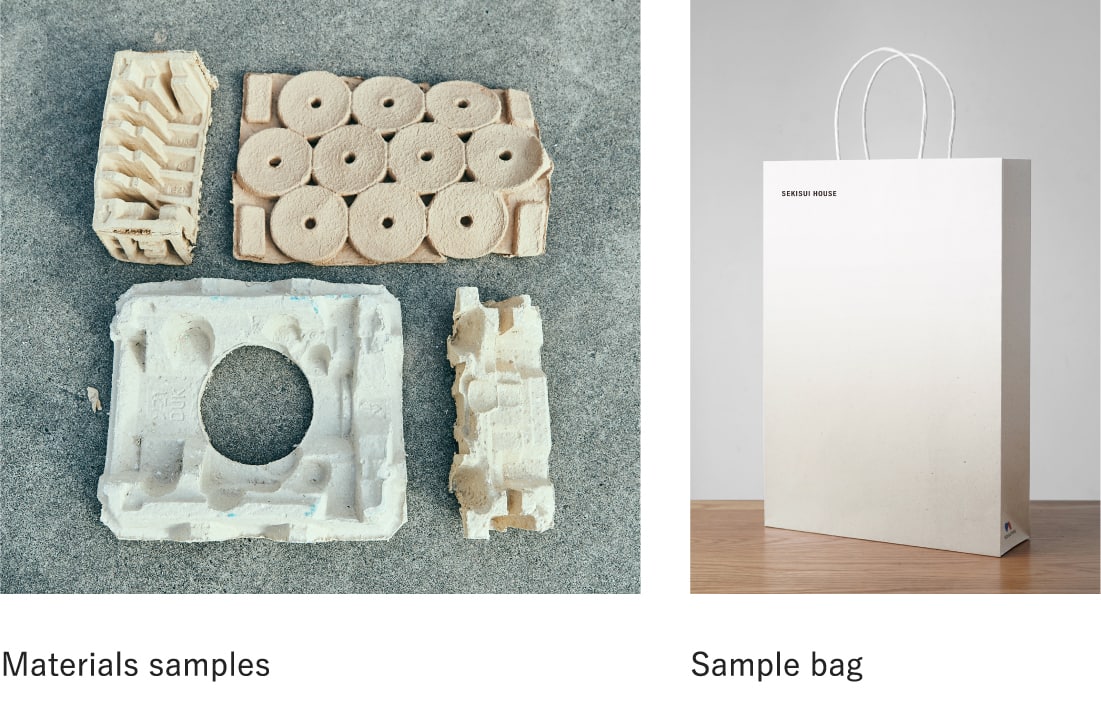
Sekisui House has launched a project to replace its plastic bags, and instead start providing recyclable paper bags. We considered a variety of materials for the new bags, ultimately selecting sanitary packaging paper used to package sanitary equipment, such as hot water heaters. This paper can be mixed with general recycled paper, without the use of virgin pulp, to be recycled into environmentally friendly paper bags. We expect this project to help alleviate environmental burden, reducing plastic use by 10,723 kg per year through the phasing out of plastic bags, and reducing virgin pulp use by 13,232 kg per year through the use of waste materials and recycled paper.
Dyne Concrete recycling
The Kanto Factory and Hyogo Factory recycle concrete waste that arises in the Dyne Concrete manufacturing process as raw materials. Scrap material bored out of exterior wall panels and concrete residue that adheres to equipment were previously disposed of as waste. Some of this material is now recycled by pulverizing it to specific grain sizes for reuse as raw materials, reducing overall resource consumption.
Bellburn recycling
Bellburn scraps are pulverized and used as filler in Sekisui House’s Shellshut Slab sound- and vibration-absorbent floor system. By replacing the inorganic sands previously used for this filler with Bellburn pulverized to specific grain sizes, we are able to reduce material input.
Reusing solid waste
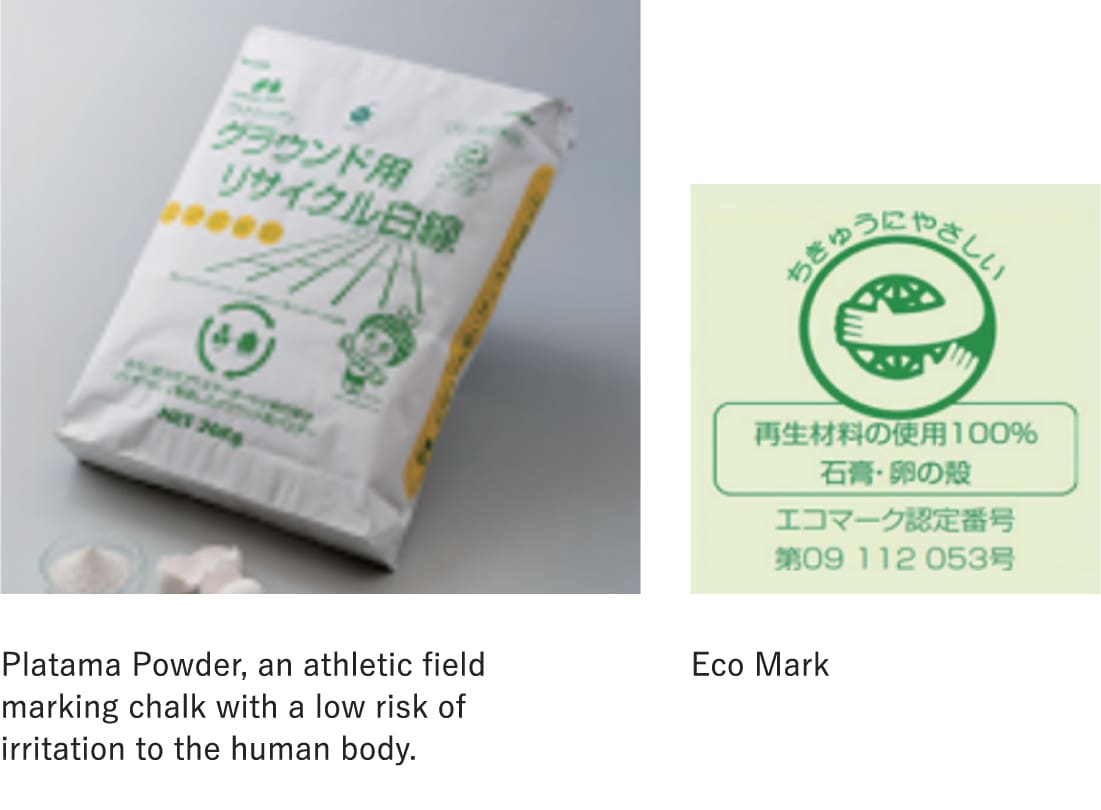
At manufacturing and processing facilities located at two of our Resource Recycling Centers, scrap plasterboard collected from new housing construction sites and eggshells from third-party food processing factories are mixed together and crushed. This produces Platama Powder, an athletic field marking chalk, which we have manufactured and sold since 2010. This initiative has enabled us to establish a new commercial distribution channel and a system for continual recycling by regularly purchasing egg shells, which were previously thrown away as food waste.
We also reuse sorted solid waste by selling it in such forms as resin materials, woodchips, power line materials, and Styrofoam materials (ingots).
| Unit | FY2019 | FY2023 | FY2024 | FY2025 | Targets | |
|---|---|---|---|---|---|---|
| Platama Powder production | t | 1,795 | 3,735 | 1,754 | 3,436 | Up 5% from FY2019 |
Initiatives to reduce hazardous waste from factory production
We are constantly considering how to use the best economically feasible technologies. One example of reducing hazardous waste is electrodeposition coating materials used for antirust treatment on steel frames. In the past, these contained a very small amount of lead, which could become hazardous waste, but since January 2003, we have switched to lead-free coatings.
Hazardous Waste Generation
| Boundary | Unit | FY2023 | FY2024 | FY2025 | ||
|---|---|---|---|---|---|---|
| Hazardous waste generation*9(Total) |
Group (Japan)*10 |
t | 763 | 979 | 210 | |
| Civil engineering and demolition | Konoike Construction Co., Ltd. | 648 | 769 |
46 |
||
| Demolition |
Sekisui House, Ltd., Sekisui House Construction Group |
66 | 156 |
56 |
||
| Manufacturing plants | Sekisui House, Ltd. | 49 | 55 |
109 |
||
*9 The Sekisui House Group defines hazardous waste as specially controlled industrial waste stipulated in the Wastes Disposal and Public Cleansing Act (flammable waste oil, scatterable asbestos, etc.), including waste regulated by the Basel Convention, such as waste PCBs.
*10 Sekisui House, Ltd., Sekisui House Construction Group, and Konoike Construction Co., Ltd.
Initiatives to Reduce Paper Use
We are prioritizing the purchase of environmentally friendly products, and purchase stationery and other office products used by our business offices across Japan in accordance with our Green Procurement Guidelines. We are also gathering and tracking data on the amount of paper used in business activities and moving forward with initiatives to ensure more efficient use. For example, working with our Group companies, we are supplying domestically produced, 100% recycled high-brightness and high-quality environmentally friendly paper, produced by the Group, to offices throughout Japan. At our production and construction sites, we are maintaining a high wastepaper and cardboard material recycling rate to promote the active use of recyclable materials.
Initiatives to Reduce Paper Use
| Boundary | Unit | FY2023 | FY2024 | FY2025 | |
|---|---|---|---|---|---|
|
Material recycling rate of wastepaper and cardboard at production and construction sites |
Sekisui House, Ltd.*11 | % | 99.9 | 99.9 | 99.9 |
*11 Scope managed by domestic factories