[ Japanese ]
Promoting Diverse Workstyles
Basic Approach
The Sekisui House Group aims to revitalize communication by reforming its work environment, upgrading the ICT infrastructure, and optimizing systems and rules. We believe it critical to promote diverse working styles that allow for flexibility and autonomy while working free from constraints of time and place to ensure that each person can work to their fullest potential. Therefore, we are working to advance a workplace culture that ensures psychological safety by creating systems that foster diverse workstyles as well as expanding systems for fair evaluations.
Appropriate management of working hours and promotion of paid leave utilization
In promoting diverse workstyles, it is crucial to eliminate long working hours and create an environment where everyone can work enthusiastically. Thus, after examining the Company’s working hours, we began by implementing initiatives focused on compliance with hours established in the “three-six agreement” under provisions set forth in the Labor Standards Act. By setting targets for monthly average monthly working hours in each division, we have worked to improve and preserve employee health and well-being by decreasing overtime hours under the Industrial Safety and Health Act.
We have also set targets for annual paid leave usage rate and days used of 85% and 17 days, respectively, for FY2025, and encourage planned leave-taking. Additionally, we are promoting autonomous workstyles through the introduction of various systems that alleviate restrictions on where and when employees work. Particularly for those employees facing time restrictions due to child-rearing and nursing care, it is essential to have systems that enable them to work with peace of mind while balancing work and life without compromising their careers. Furthermore, starting from March 2023, regardless of continuous years of employment, all employees are immediately granted 20 annual days of paid time off. (Employees previously acquired additional paid leave with each year of tenure until reaching a maximum of 20 days under the conventional paid leave system in Japan.) This initiative is part of our support for employees to realize healthy and autonomous workstyles while finding balance between their professional and personal lives. The annual paid leave take-up rate for the domestic Group companies in FY2025 was 83.0%.
Offering a Variety of Workstyle Programs
Working hour arrangements: Staggered Working Hours System
Since April 2018, to encourage work-life balance and efficiency while maintaining standard working hours, we have promoted flexible workstyles that allow individuals to adjust their start time in 15-minute intervals between 7:00 a.m. and 11:00 a.m. Each employee is mindful of their working hours and actively engages in discussions with their supervisors to make the most of this system.
Remote work system
Starting in February 2017, we implemented our Work-from-Home System to allow employees who need flexible working hours due to matters such as child-rearing to actively contribute more effectively. The temporary implementation of a Company-wide remote work initiative due to the COVID-19 pandemic made working from home and even mobile work a possibility for all employees. Employees are now able to choose their work locations accordingly. Although the standard number of days one can work from home per month is seven, if a special request is approved, it can be increased to eight or more.
Changing designated days off system (Your holiday system)
In October 2024, we introduced a system at offices—where the designated days off are Tuesday and Wednesday—that allows employees to shift one of their designated days off each month to a Saturday or Sunday. This initiative aims to foster a workplace where all employees can work autonomously and grow continuously, while better accommodating their personal and family needs, such as spending time with family and friends or engaging with the local community.
Expanding support systems for our employees’ work-life balance
Shortening or changing working hours for childcare needs
Employees who care for children up to the third grade of elementary school can apply for a reduction in their standard working hours. This can be set for each day of the week, up to two hours per day, in 15-minute increments. Additionally, until their children enter sixth grade, these employees are permitted to adjust their start and end times within the range of 7:00 a.m. to 8:00 p.m., allowing them to either start earlier or finish later, provided they work the standard number of hours.
Support for nursery school hunting
For employees who plan to return to work within one year after childbirth and need support in finding a childcare facility, we provide individual support from pregnancy to the decision on a childcare facility by providing information on activities, expertise, and childcare-related topics according to the individual’s circumstances, such as the child’s birthday and their place of residence.
Nursing care support
Employees who provide nursing care for family members in need of care are eligible to use support programs such as shortened prescribed working hours (up to three hours per day), reduced prescribed working days (one day per week), or adjustments to their working hours. In addition, employees may take paid “Family Care Leave” or “Child Nursing Care Leave” of up to five days per year (or ten days if there are two or more eligible family members), which can be taken on an hourly basis. From 2024, nursing care–related surveys have been conducted every November at many Group companies to help identify and develop measures that are responsive to employees’ needs. Furthermore, employees may receive individualized consultations through internal or external consultation services upon request.
Childcare support leave
Outside of our existing systems for child-rearing and nursing care, we support career continuation for employees with children up to the age of 18 who require additional attention due to medical conditions or absence from school. We allow these employees to take leave for up to two years, shorten standard working hours and days, and utilize other similar measures.
Support programs for balancing medical treatment with work
To enable employees undergoing treatment for cancer, infertility, designated intractable diseases, disabilities, etc. to continue working with peace of mind, we allow them to shorten their standard working hours and/or days, change their working hours, and utilize other similar measures. In addition to creating work environments that facilitate a balance between medical treatment and work, these measures help ensure a smooth return to work following treatment.
Work Area Continuity System (for medical treatment, child-rearing, and nursing care support)
Due to medical treatment, nursing care, child rearing, or other circumstances, this system allows employees to continue working in the same area without having to relocate. Employees can apply to use this system during the period in which they meet prescribed eligibility requirements. This system was launched in August 2025, and 91 employees of the Group*1 are currently using it.
*1 Sekisui House, Ltd., Sekisui House Real Estate Group, and Sekisui House Support Plus, Ltd.
HR programs and processes
In addition to efforts focused on diversity and inclusion and workstyle changes, with the goal of supporting self-directed career development, we positioned 2021 as the inaugural year for reforms to our HR programs and processes and revised our grading, performance evaluation, and compensation systems. We are also implementing and considering HR program reforms at Group companies.
Implementing multiple career tracks for managers
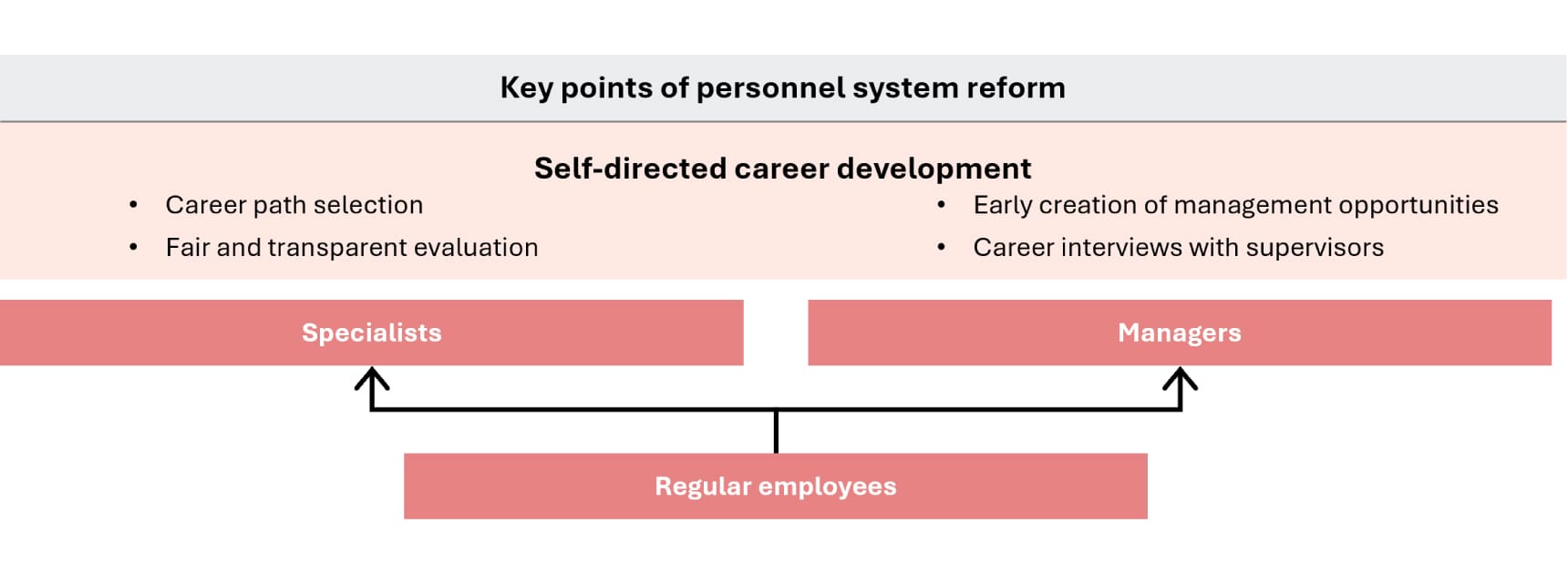
We have established two types of career tracks for managers: direct managerial positions and specialist positions that contribute to the organization through high-level expertise. We implement HR systems that empower employees to choose and realize their own career paths.
Managerial appointment system
As part of the revision of our personnel system in April 2022, the number of grades for non-managers was reduced from nine levels to five, creating a system for the early promotion of talented employees to managerial positions. In April 2023, we further accelerated this process and revised the rules to allow employees to be promoted to managerial positions after a minimum of five years from the time of joining the Company. This establishes promotions and appointments based on individual ability and merit, regardless of age or years of service in the Company.
Outline of New HR Programs and Processes
Expanding Systems for Fair Evaluations
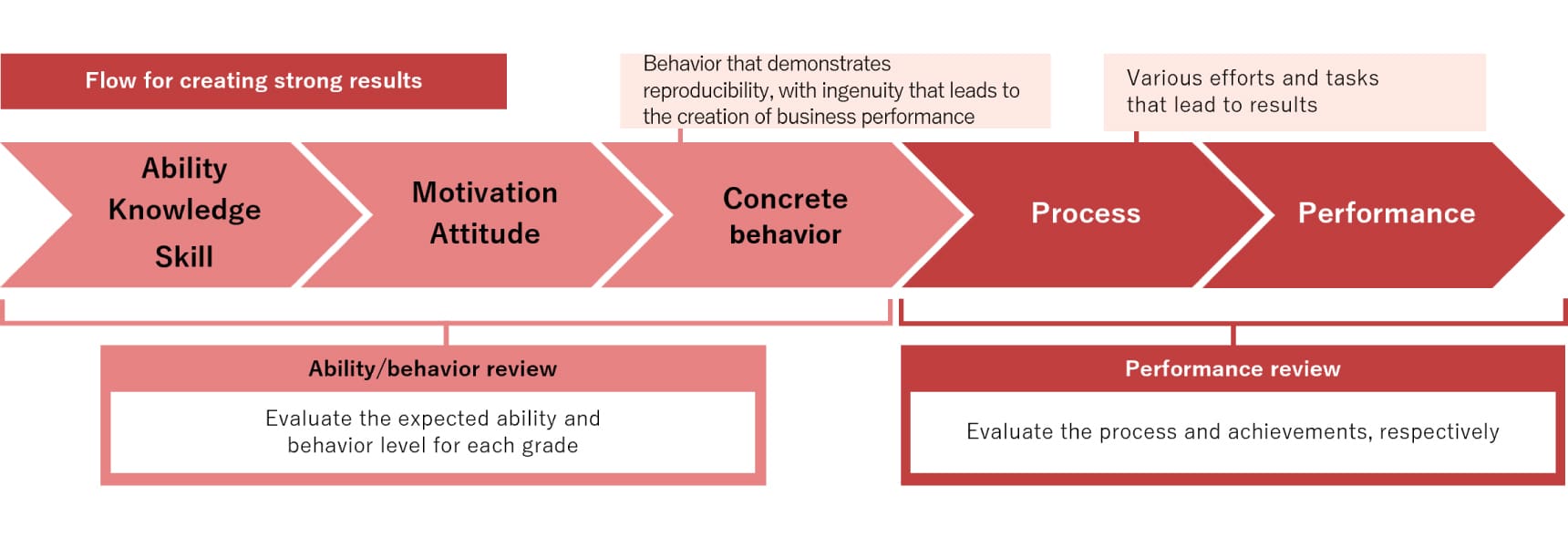
The Group emphasizes fair and transparent employee evaluations. Accordingly, since FY2010, we have been sharing evaluation results with employees and conducting interviews to discuss individual strengths and areas for improvement. Additionally, in FY2021, we revised our evaluation system in alignment with the introduction of our new personnel system. To appropriately assess each employee’s abilities and achievements in a way that creates environments that help them maintain their motivation to continue working, evaluations are conducted from two perspectives: an ability/behavior review and a performance review. In the ability/behavior review, we evaluate the employees’ abilities, knowledge, and skills; motivation and attitudes; and the resulting concrete behaviors. In the performance review, we assess the process used to achieve final results using management by objectives (MBO), as well as the resulting performance. The outcomes of this review are reflected in performance bonuses, while the ability/behavior review informs promotions, salary increases, and retirement benefits. Additionally, the sales divisions are provided with monthly performance allowances based on individual performance.
In addition to quantitative results, our new evaluation system incorporates qualitative assessments such as the willingness to take on new challenges, the level of contribution, and demonstrated creative abilities. This approach enables a more comprehensive evaluation of each employee. Furthermore, we have established certification criteria and competency standards for specialists who contribute to the Company through their high degree of expertise. This clarifies our ideals and expectations for each specific job position. In evaluator meetings, evaluations are conducted following careful deliberation and scrutiny through multi-perspective discussions among evaluators. Opportunities for promotion and remuneration are then offered based on fair evaluations that reflect each individual’s achievements, regardless of their tenure or age, in relation to their fulfillment of requisite abilities and roles.
Grading System Overview
Risk management in engagement
We conduct an annual Governance Awareness Survey for all domestic Group employees to monitor current conditions within the Group regarding our corporate philosophy, code of conduct, vision and strategy, employee autonomy, workplace culture, and compliance. Based on the survey results, we encourage department heads to identify and resolve issues in their departments, and to reflect organization-wide issues in Company policies and training programs, working to retain human capital by improving employee engagement. Key initiatives are as follows.
- We established certification criteria and competency standards for specialists (SP positions) who contribute to the Company through their high degree of expertise and clarified our ideals and expected roles for such positions. We are also exploring ways to make specialist positions more appealing.
- We conducted MBO e-learning for evaluators and participants being evaluated. Participants learned how to set goals to achieve growth through their work, handle evaluation results, and use those results in the future. Sharing growth challenges through mutual communication will lead to more understandable and transparent grading, resulting in higher motivation, personal growth, and organizational success.
Results of the Governance Awareness Survey
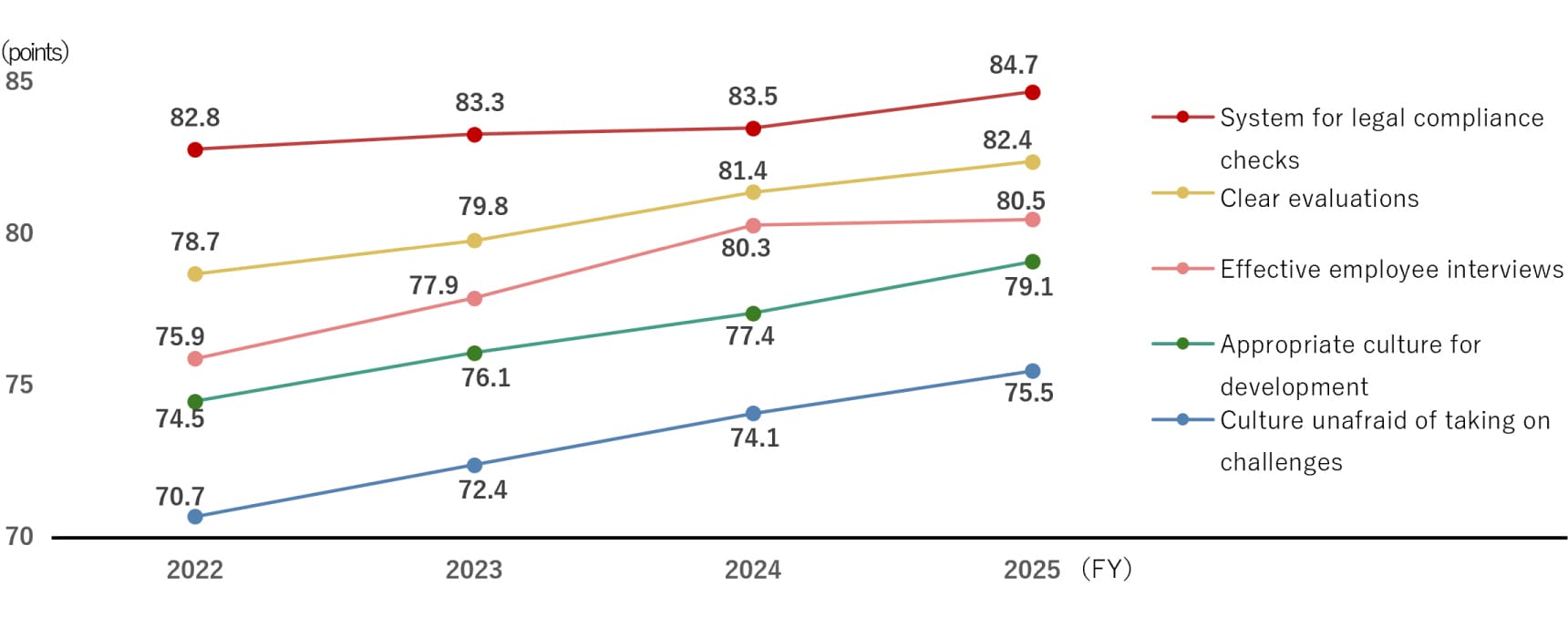
In the developing human resources section of the Governance Awareness Survey, we evaluate items related to interviews, evaluations, and the organizational culture of development. Scores have consistently improved across all indicators over the years since 2022, reflecting the steady effectiveness of our fair evaluation system. However, building a culture where employees are unafraid to take on challenges remains an area for improvement across the board, highlighting the need to foster this mindset while maintaining strong governance and legal compliance
Changes in the Governance Awareness Survey’s Score at Sekisui House Branch Stores
Creating a Workplace Culture that Ensures Psychological Safety
Career interviews
Establishing a workplace culture that provides peace of mind and safety based on a relationship of trust is crucial in promoting diverse workstyles and building strong relationships between supervisors and team members. This commitment is evident in the Sekisui House Group’s personnel measures, which include holding career interviews five times per year. The Group’s career interviews are characterized by listening carefully to the opinions of our employees. During these interviews, employees openly discuss the challenges they face, their strengths, accomplishments, and goals, with supervisors listening and responding thoughtfully. This practice extends beyond a top-down work progress check; it is an opportunity for employees to clarify their personal goals and articulate their career plans. Supervisors take the opinions and wishes of employees seriously, and after thoroughly understanding each individual’s situation, they provide appropriate advice and pose relevant questions, thereby encouraging behavioral change and growth. These career interviews facilitate open dialogue between supervisors and employees, contributing to the creation of a psychologically safe workplace through trust and effective communication. Furthermore, they enable employees to collaborate in identifying solutions to problems, thereby enhancing employee engagement and overall organizational performance.
The Group conducts an awareness survey biannually for supervisors and team members who participate in these career interviews. The analyzed survey results are shared with employees, along with best practices and techniques for optimizing the career interviews. Survey results for the second half of FY2025 indicate a career interview satisfaction rate of 7.2 out of 10. Additionally, 95%*2 of employees felt that their supervisor listened attentively to their concerns and 92%*2 felt that their supervisors appropriately acknowledged their strengths. We also provide opportunities for supervisors to enhance their coaching and listening skills. Through these interview skill-related improvements, we strive to foster thorough communication and relationships of trust between supervisors and team members.
*2 Percentage of those who responded with “strongly agree” or “agree” on a four-point scale consisting of “strongly agree,” “agree,” “slightly disagree” and “disagree.”
Organizational development support program
In organizations comprising diverse human resources, it is essential to build relationships of mutual trust between leaders and team members and to develop a workplace culture that ensures psychological safety. We launched the organizational development support program in November 2024, and to date we have hosted dialogue-based sessions at 12 sites. Through these sessions, we have helped to enhance communication and promote alignment between leaders and team members on future courses of action. In doing so, we are promoting the creation of an organization that does not fear failure and works toward lofty targets.
Promoting diversity management initiatives
We believe that leaders play a crucial role in creating workplace environments where diverse workstyles are possible. Thus, we held forums on balancing work and child-rearing for relevant employees and their supervisors from 2015 to 2021. This forum was transformed into the Diversity Management Forum in 2022, and is now offered to all leaders (primary evaluators*3). Through this change, it has become a training program for developing leaders who promote the participation, work-life balance, and flexible workstyles of employees. This forum supports these leaders by presenting a diversity of challenges not only related to child-rearing but also nursing care and medical treatment. The creation of a psychologically safe workplace is linked to the development of leaders who can leverage the talents of our diverse employees.
*3 Supervisors whose priority is providing consultations on flexible workstyles for achieving a work-life balance
Utilizing the Well-Being Survey to measure effectiveness
The annual Well-Being Survey for all employees includes a section on workplace happiness covering the “willingness to recommend current workplace,” “atmosphere of workplace trust,” “culture of safety and peace of mind,” and “atmosphere that encourages challenges.” We verify the progress and outcomes of promoting diverse workstyles through these indicators. In FY2025, As results have remained flat compared to FY2024, we will step up efforts to improve.
| Boundary | Unit | FY2023 | FY2024 | FY2025 | |
|---|---|---|---|---|---|
| Workplace happiness |
Group (Japan)*4 |
points | 66.59 | 67.44 | 67.39 |
*4 Sekisui House and domestic consolidated subsidiaries, excluding Konoike Construction