[ Japanese ]
Improving Social Value
Governance
Policies and initiatives related to the improvement of social value are discussed by the ESG Promotion Committee, an advisory body to the Board of Directors. Depending on the content, outcomes of these discussions are presented at Management Meetings or Board of Directors meetings, where Company-wide measures are implemented and managed. The ESG Promotion Committee includes two external members with specialized expertise who actively participate in discussions. Through these active discussion and exchanges of opinions, they establish initiatives and policies that contribute to solving social issues.
Structure for improving social value
Relevant departments are responsible for formulating strategies, implementing policies, and managing the progress of each measure. The Social Improvement Subcommittee, operating under the ESG Promotion Committee, discusses and manages the progress of initiatives aimed at enhancing human capital value and improving social value, with the goal of responding flexibly and effectively to the needs of and issues faced by various stakeholders, including employees and their families, customers, the supply chain, and regional communities.
Diverse perspectives and experiences are incorporated through the participation of members from different departments, enabling more comprehensive decision-making. Moreover, by periodically evaluating the progress of goal achievement and making necessary adjustments and improvements to strategies, we are strengthening initiatives aimed at organization-wide social improvement.
Structure for the Social Improvement Subcommittee (as of February 1, 2026)
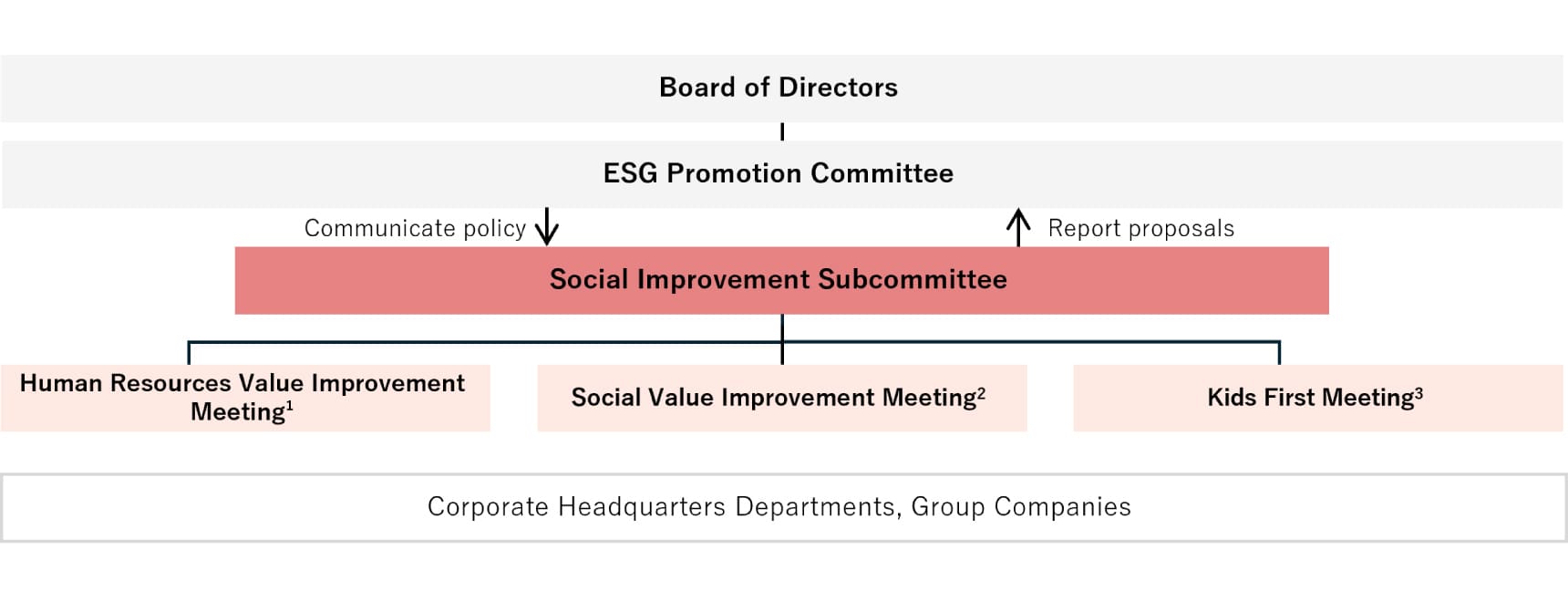
*1 Managing policies, initiatives, and progress that contribute to employees’ autonomy, happiness, and alignment of direction.
*2 Sharing initiatives to address social issues and enhance social value through our business, including regional revitalization.
*3 Promoting Kids-First initiatives from both business and activity perspectives, with cross-departmental sharing of progress.
Strategy
Basic Approach
The accelerated aging of society and low birthrate, the appropriate implementation of disaster prevention and mitigation measures, regional depopulation, and relative poverty among children are all pressing issues. Particularly since the COVID-19 pandemic, the issues facing specific regions, as well as the needs of their inhabitants, have diversified. These changes necessitate community development tailored to individual cultures and climates.
To address social issues such as longer lifespans across society and regional revitalization through our business, we are advancing community development by enhancing existing infrastructure services such as medical care, nursing care and welfare, and integrating them with real estate. The Group leverages its comprehensive proposal capabilities by integrating ESG considerations with its technologies, lifestyle design, and services. Through this strength, and in collaboration with homeowners and organizations ranging from NPOs to governments and public welfare organizations, we aim to create and maintain strong relationships between residents and property operators, fostering a society where people can be happy in their communities throughout their lives.
With a focus on children and the environment, we are actively working to create a society and environment where future generations can continue living happy lives. Additionally, we are developing initiatives aimed at solving issues faced by local communities by leveraging the specialized knowledge and expertise of our employees.
Fundamental policy for improving social value
The Group’s strategy to improve social value is aimed at contributing to a sustainable society and creating social value. The four pillars at the heart of this strategy are: “Kids First,” “Green First,”*4 respect for human rights, and regional revitalization businesses. Through these pillars, we aim to address social issues and have a positive effect on local communities, the environment, and people’s lives, thereby increasing societal happiness. Moreover, implementing each strategy involves cooperation with relevant parties, effective resource allocation, and the evaluation of sustainable outcomes.
*4 Please refer to the Environment Section for initiatives related to “Green First.”
Risk Management
The relevant departments analyze risks and opportunities related to human rights and regional communities and consider appropriate countermeasures. These are then discussed within the Social Improvement Subcommittee to foster cross-departmental cooperation. Significant risks and opportunities are reviewed by the ESG Promotion Committee, an advisory body to the Board of Directors, and subsequently reported to the Board of Directors, contributing to the formulation of medium- to long-term strategies. In particular, with respect to human rights, we identify and manage human rights risks related to our Group's operations through human rights due diligence.
Furthermore, important risks identified by relevant departments are reported to the Risk Management Committee and subsequently reviewed and managed within the Group’s overall risk management system
Metrics and Targets
We have set key performance indicators (KPIs) in the Sixth Mid-Term Management Plan and disclose details of these initiatives as well as the status of their progress.