[ Japanese ]
Respect for Human Rights
Based on our Human Rights Policy, we have incorporated human rights due diligence processes into our business activities and are promoting initiatives for top management, all Group employees, customers, supply chains and people working at partner building constructors. In this report, we seek to clarify the overall picture, progress and issues regarding our human rights initiatives and fulfill our responsibility of “Disclosure” as stipulated in our Human Rights Policy.
Basic Approach
The Sekisui House Group respects the human rights of all stakeholders who may be affected by its business activities, including employees and suppliers.
The Group published the Sekisui House Group Human Rights Policy (hereafter referred to as the “Human Rights Policy”) in April 2020. This policy clearly states our commitment to prohibiting all forms of discrimination and harassment, as well as forced labor and child labor.
Strict compliance with the Human Rights Policy is mandatory for all Executive Officers and employees of the Sekisui House Group, and we promote understanding and awareness of the policy through training and other initiatives.
Map of Human Rights Risks Related to Group Businesses
Identifying and Responding to Important Human Rights Issues in Our Business
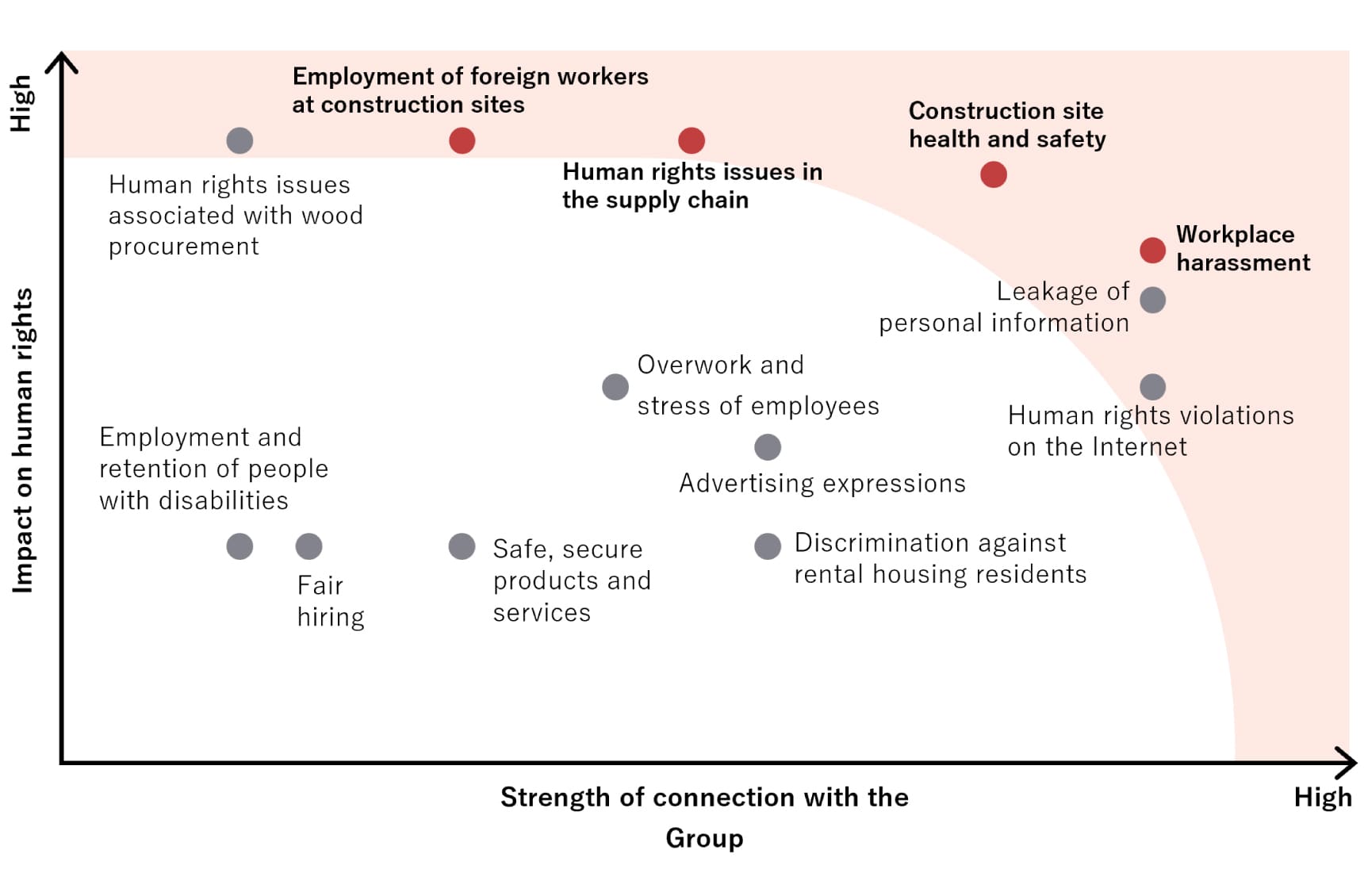
At the Human Rights Due Diligence Meeting, we identify and regularly review important human rights issues during the annual process of creating a Human Rights Risk Map (bottom left diagram).
The four important human rights issues identified in FY2025 are: 1. Workplace harassment, 2. Construction site health and safety, 3. Human rights issues in the supply chain, and 4. Employment of foreign workers at construction sites.
Important issue 1: Workplace harassment
With approximately 30,000 employees, ensuring a psychologically safe and well-structured work environment is a key priority for the Group.
Accordingly, the Group has established the Sexual and Power Harassment Hotline and ensures that all Group employees are aware of it. The hotline provides a wide range of consultations regarding all kinds of human rights issues. We promptly respond to these consultations, conducting investigations and taking corrective, remedial and recurrence prevention measures as necessary. The verification results of these consultations are incorporated in our Human Relations Training for all employees. In doing so, we are working to prevent harassment and ensure an appropriate response when incidents occur.
Important issue 2: Construction site health and safety
Construction site work environments are hazardous, and missteps can readily lead to life-threatening accidents. Accordingly, occupational health and safety is an issue of the highest priority for the Group. We have various measures in place to ensure that construction workers can work in a safe environment.
Important issue 3: Human rights issues in the supply chain
The Company has established the CSR Procurement Guidelines, which include respect for human rights and labor rights, and shares these guidelines with its major suppliers. Suppliers are required to submit a signed agreement annually, and new suppliers must also provide one when starting transactions with us.
We conduct yearly CSR evaluations for suppliers based on the Global Compact Network Japan (GCNJ*1)’s self-assessment questionnaire. Based on the evaluation results, we conduct monitoring of suppliers identified as requiring attention and verify their actual situation. We have been working to promote understanding and awareness of our Human Rights Policy through annual activity policy briefing sessions attended by our main suppliers. By expanding these initiatives from our suppliers to their suppliers, we advance respect for human rights across the supply chain.
*1 Global Compact Network Japan
Important Issue 4: Employment of foreign workers at construction sites
The number of foreign construction workers is increasing at the Group’s construction sites, and we have discovered that the ratio of occupational accidents is higher among foreign workers than Japanese workers. We therefore focused on possible contributing factors, such as a lack of Japanese understanding and inadequate dissemination of danger-related information due to the lack of communication. In response, we have adopted ten standardized safety signs issued by the Japan Construction Occupational Safety and Health Association that use pictograms and multiple languages, and created supplementary training textbooks in different languages and using simple Japanese to be provided at the time of employment.
For technical trainees, we have set up a consultation desk both for the trainees and partner building contractors. For our Vietnamese technical trainees, of whom there are a particularly large number, in addition to supporting both education and livelihood, designated staff work with supervising associations to hold periodic interviews, engaging in dialogue from a different standpoint from the employer. We also check and provide advice on their Japanese language learning.
Structure for Promoting Respect for Human Rights
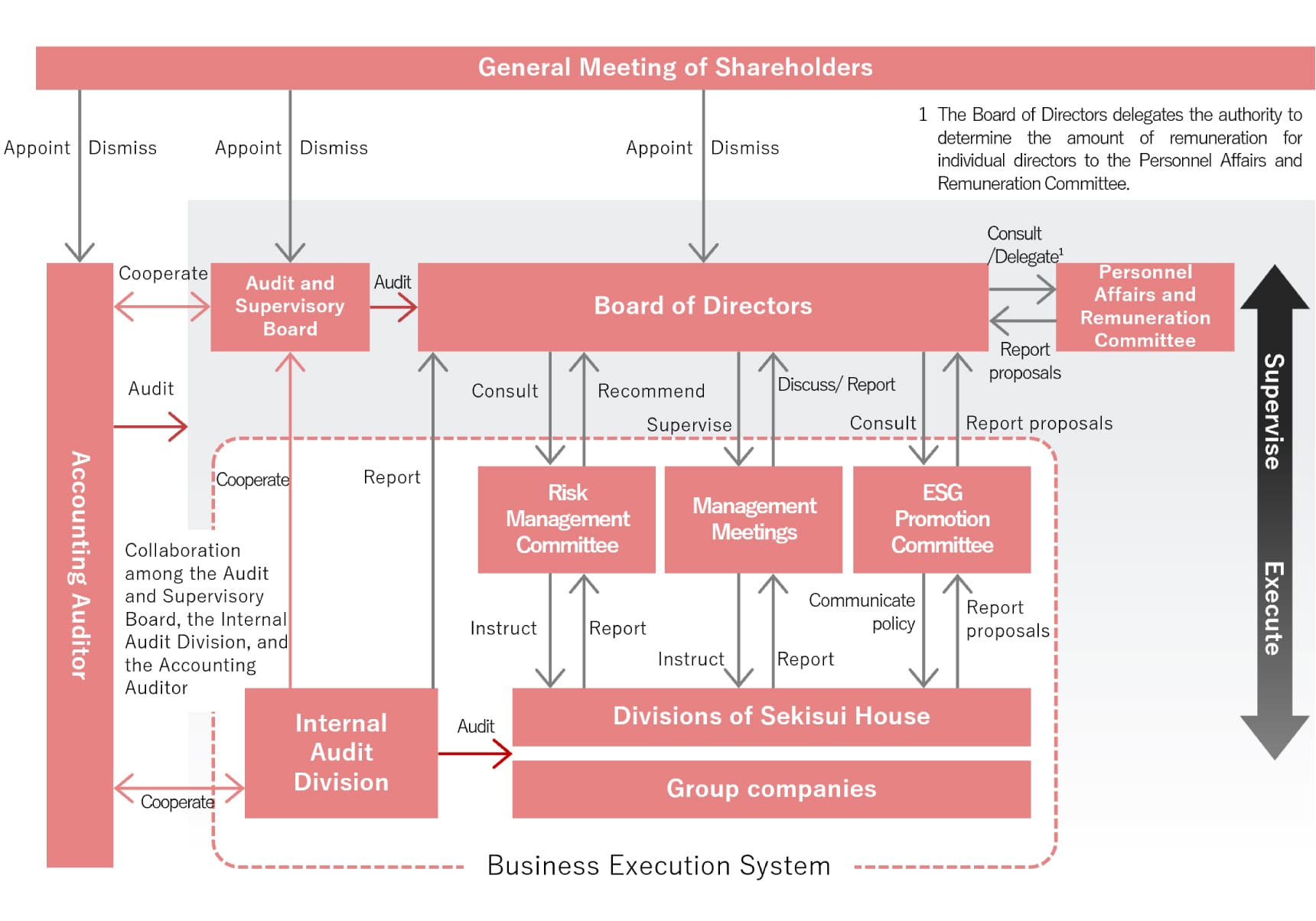
The Company has established the Human Rights Policy, with the Board of Directors overseeing compliance and initiatives related to the policy. The Management Meetings, ESG Promotion Committee, and Risk Management Committee operate under the Board of Directors, working together to create a Group-wide structure for promoting respect for human rights.
Additionally, we have established the Human Rights and Compliance Promotion Department within the Sekisui House as a dedicated department for overseeing human rights.
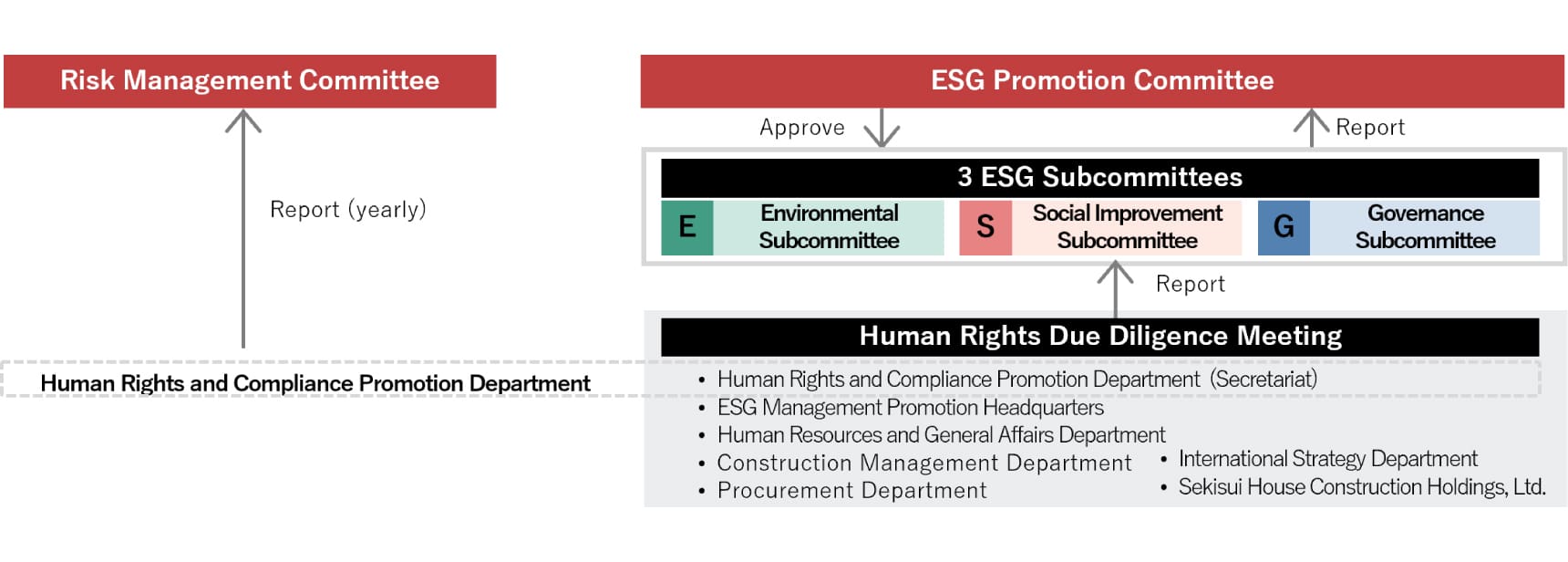
Guided by the ESG Promotion Committee, the Governance Subcommittee determines key issues and policies related to human rights. This Subcommittee also holds the Human Rights Due Diligence Meeting (secretariat: Human Rights and Compliance Promotion Department), which includes multiple related divisions, taking charge of the Group’s approach to various human rights issues and sharing information collaboratively to ensure the promotion of human rights.
The Risk Management Committee receives regular reports regarding measures promoting human rights. Risk Management Committee members debate and strategize around themes related to human rights. These primarily relate to Group employee labor and health, harassment and occupational accidents from the point of view of risk management.
Corporate Governance Structure(As of February 2026)
Human Rights Due Diligence System
Consultation System for Human Rights-Related Concerns
The Group has established multiple reporting systems, including the Sekisui House Group Compliance Support System, the Sexual and Power Harassment Hotline, and the Sekisui House Global Helpline, all managed by the Human Rights and Compliance Promotion Department. We aim to enhance our consultation desk network through the effective operation of these systems.
Additionally, we promptly address consultations and reports, conducting investigations and taking corrective and remedial measures as necessary. We strictly protect confidentiality, ensuring that users of these services will not suffer any disadvantage as a result of making a consultation or report.
Consultation personnel for sexual and power harassment at business sites
We have assigned one male and one female employee each to serve as consultation personnel at all our business sites in Japan, including at Group companies. As of March 2026, there are 736 consultation personnel in total. The Human Rights and Compliance Promotion Department conducts annual training sessions for these consultation personnel to enhance their skills in handling inquiries and strengthen cooperation.
Sexual and Power Harassment Hotline
The Sexual and Power Harassment Hotline receives a wide range of consultations regarding various forms of harassment and human rights-related issues from the Group’s employees and ongoing business partners. Every case received is addressed. In addition to corrective actions, advice and support are offered to the consultee depending on the nature of the consultation. Most of the non-harassment consultations are related to management and human relationships in the workplace.
Cases Managed by the Sexual and Power Harassment Hotline
| Boundary | Unit | FY2023 | FY2024 | FY2025 | ||
|---|---|---|---|---|---|---|
| Total number of consultations received |
Group (Japan) |
Cases | 253 | 258 | 309 | |
| Of which, cases regarding harassment complaints | 131 | 150 | 196 | |||
| Of which, cases involving corrective action | 76 | 83 | 130 | |||
As the data shows, the number of consultations received by the Sexual and Power Harassment Hotline is increasing yearly. The Group believes that early consultation is crucial for preventing and mitigating harassment. Additionally, we recognize the importance of providing a secure and confidential environment where individuals can speak up outside of the formal reporting line, ensuring that no one is left to struggle alone. Through consultation services and awareness-raising efforts, we have worked to create an environment where employees feel comfortable seeking advice. We view the increase in consultations as a positive indicator of the trust we’ve established. We believe that the number of consultations will continue to increase as we proceed with these efforts. We will use the content and trends of these consultations, as well as changes over time, to implement new measures, including employee training.
Human rights inquiries on our public website
Since the establishment of the Human Rights Policy in April 2020, we have accepted both internal and external inquiries related to human rights via our public website. In FY2025, we looked into and responded as needed to all eight inquiries received, and we did not identify any serious human rights violations inflicted by the Group’s business.
| Boundary | Unit | FY2023 | FY2024 | FY2025 | |
|---|---|---|---|---|---|
| Human Rights Inquiries on Public Website | Inquiries from the general public | Cases | 32 | 10 | 8 |
Continuous Human Rights Training for Employees
To raise awareness of human rights issues and foster a comfortable work environment, we conduct annual human rights and compliance training for all Group employees*2. This training aims to improve employees’ awareness of human rights and provides them the opportunity to consider human rights as a personal issue in their daily work. The training style emphasizes dialogue among employees, with the head of each organization acting as facilitator. In addition to the human rights and compliance training, we annually promote awareness among all employees of our human rights consultation services by displaying the human rights slogan on the Company intranet and posters at business sites.
*2 Participation is voluntary for temporary, part-time and fixed-term employees, but training manuals are distributed to them. In addition, some Group companies, including those overseas, conduct their own training tailored to their business activities; however, participants in such training are not included in the number of participants in this training.
| Boundary | Unit | FY2023 | FY2024 | FY2025 | |||
|---|---|---|---|---|---|---|---|
| Human Relations Training*3 | Rate of employees by organization | Groupe (Japan) | % | 100 | 100 | 100 | |
| Training for all employees | Number of participants | Persons | 24,260 | 23,156 | 25,755 | ||
| Training time |
Hours/ Persons |
3.0 | 3.0 | 3.0 | |||
| Training for promotion leaders | Number of participants | Persons | 6,864 | 6,635 | 7,396 | ||
| Training time |
Hours/ Persons |
2.0 | 2.0 | 2.0 | |||
*3 Some Group companies, including overseas subsidiaries, conduct their own training programs tailored to their business activities; however, participants in these programs are not included in the number of attendees for this training.
Collaboration with Stakeholders
Ensuring respect for human rights in overseas business activities
Between 2024 and 2025, members of the Human Rights Due Diligence Meeting visited Group company construction sites in Australia, the U.S., Thailand, and Vietnam, to conduct onsite due diligence. Through onsite observations, interviews, and direct dialogue with Group company supervisors responsible for overseeing construction sites and local staff, we checked the human rights conditions of local staff and employees of partner building contractors, as well as initiatives to prevent and reduce human rights issues.
Customer initiatives
The Group believes that continued dialogue with customers contributes to the provision of high-quality housing and is an important corporate responsibility. Even after housing is provided, we collect customer feedback through regular inspections and questionnaires, utilizing this information to improve the quality of our products and services. Moreover, to promote LGBTQ+ friendly practices when finding tenants for rental housing properties, Sekisui House Real Estate Group delivers ongoing training for its employees and affiliated distributors to provide living environments that respect diverse values. By addressing the diverse needs of our customers, our Group is helping to build a society in which all people can receive services fairly.
Cooperation with human rights groups and external stakeholders
In 2018, the Company signed and endorsed the Ten Principles in the four fields of human rights, labor, environment, and anti-corruption stated in the United Nations Global Compact. Following this, we joined the subcommittees (Human Rights Due Diligence, and human rights education) of the Global Compact Network Japan, a local network based in Japan, to promote corporate respect for human rights. We also collaborate with organizations addressing various human rights issues—including the Buraku (marginalized communities) issue—to collect the latest information for in-house education and training, aiming to raise employee awareness of human rights.
Compliance with and response to labor standards
The Company considers compliance with labor standards an important responsibility. We respond to all claims related to labor standards by conducting appropriate investigations and providing necessary guidance. In particular, when a claim is made regarding working hours, we review the operational status of the relevant business site and provide appropriate guidance, including measures aimed at improving operational efficiency. This initiative is part of our internal compliance management and contributes to maintaining a workplace where employees feel safe and secure by continuously improving the working environment.
In FY2025, we received no recommendation for corrective action by the Labour Standards Inspection Office in relation to working hours.